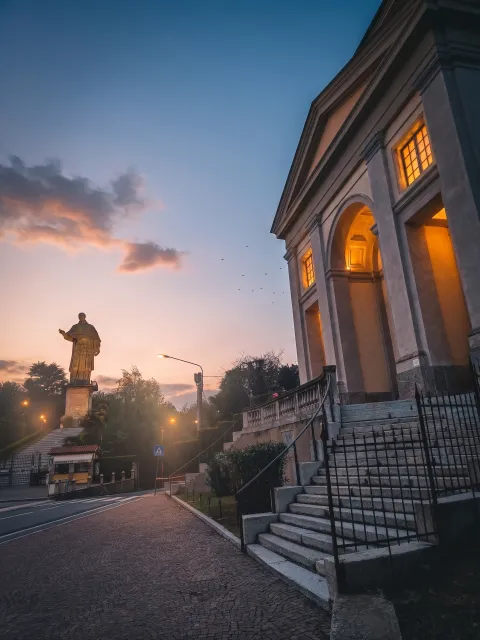
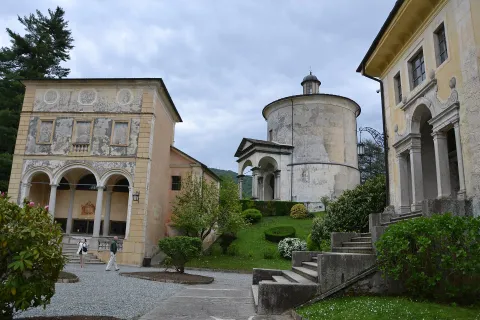
In 1583, the local community decided to establish a devotional complex on the San Nicolao hill overlooking the eastern shore of Lake Orta, encouraged by Saint Charles Borromeo and Abbot Amico Canobio. Built in response to the Counter-Reformation and inspired by the Sacro Monte di Varallo, the Sacro Monte di Orta has been protected as a UNESCO World Heritage Site since 2003 and a regional special nature reserve since 1980.
What to see
Designed by the Capuchin friar and architect Cleto da Castelletto Ticino, the site was originally planned to host up to 36 chapels, though 20 were constructed between 1590 and 1785. Unlike other sacred mounts in the region, the entire site focuses on the life and miracles of Saint Francis of Assisi. The entrance gate features a statue of the saint carved by Dionigi Bussola and an inscription crediting love as the author of the work. Across the chapels, visitors can observe 376 life-size painted terracotta statues set against frescoed walls. The decorations showcase the work of Mannerist and Baroque artists, including sculptors Giovanni d'Enrico and Cristoforo Prestinari, alongside painters such as the Fiammenghini brothers, Morazzone, Antonio Maria Crespi, and brothers Carlo Francesco and Giuseppe Nuvolone, who painted Chapels X and XVII. At the center stands the Church of Santi Nicolao e Francesco, rebuilt in the 17th century, which holds walnut furnishings, 18th-century paintings by Cantalupi, Busca, and Procaccini, and a German wooden Pietà dating to the 10th or 11th century, known as the Mother of the Redeemer.
Visiting
The visiting route winds through the 20 numbered chapels, starting historically with Chapel XX, built in 1591 to depict the canonization of Saint Francis. Chapel III commemorates Bishop Carlo Bascapè of Novara, who personally supervised the architectural and artistic design between 1593 and 1615. The complex includes two friaries: the Convento Grande, converted to private ownership following the Napoleonic period, and the Convento Piccolo, which remains active under the Friars Minor. The site forms a key stop along the CoEur route and the historical Peregrinatio path linking Lake Orta with Varallo Sesia.
Our editors' tip
Beyond its artistic significance, the mountain holds a notable place in European literary history. In early May 1882, philosopher Friedrich Nietzsche visited the site with Lou Andreas-Salomé, an excursion remembered as the "Orta idyll" and later recounted in Salomè's writings and Laura Pariani's novel La foto di Orta.