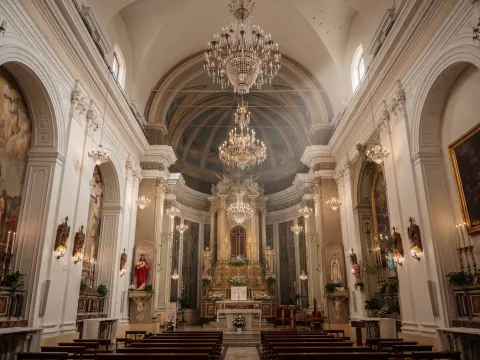
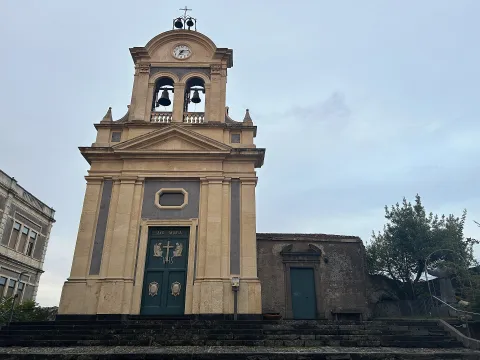
The church of San Giuseppe belongs to the generation of churches raised in Nicolosi during the first half of the eighteenth century, as the town on Etna's southern slopes completed its second life. The first had ended in 1669, when one of the most destructive eruptions in the volcano's history erased the settlement: the lava started on 8 March amid relentless earthquakes and only stopped on 11 July, after piling up the twin cones known today as the Monti Rossi.
The people of Nicolosi flatly refused to move to the newly founded Fenicia Moncada together with the inhabitants of nearby Malpasso, today's Belpasso. Their stubbornness paid off: the prince of Campofranco, vicar of the Spanish king, allowed them to rebuild on the original site around 1670-1680; administrative autonomy came in 1676, and in 1681, with 844 inhabitants, Nicolosi was recognised as a self-governing community. San Giuseppe was born of this recovery, in the same decades as the churches of Santa Maria delle Grazie and the Madonna del Carmelo.
What to see
Read the building as one piece of the eighteenth-century town: together with its contemporaries Santa Maria delle Grazie and the Madonna del Carmelo it forms the religious core of rebuilt Nicolosi, joined in the nineteenth century by the church of San Francesco di Paola and the chapel of Saints Cosmas and Damian. The town also keeps the memory of the three quarters of the old village — la Guardia to the south, il Piano to the north, la Chiesa in the middle — which had grown around the Benedictine monastery of San Nicolò, documented from 1359.
Visiting
Nicolosi is the historic gateway to Etna: travellers climbing the volcano from the south pass through here, and the town hosts the headquarters of the Etna Park. Altitude keeps summers markedly cooler than on the Catania coast, while in winter it snows on average a couple of times a year. The church stands in the compact centre, easily covered on foot; as in most small Sicilian towns, opening generally follows the schedule of services.
Our editors' tip
After your visit, walk to the junction of via Martiri d'Ungheria and via Catania. Beneath the buildings lies the first mother church of Nicolosi, dedicated to the Immaculate Conception and buried by the volcanic sands of 1669. There is nothing to see at street level, and that is exactly the point: few places explain so plainly what it means to rebuild a town on top of itself.