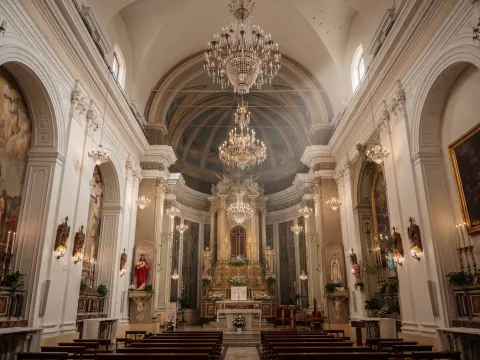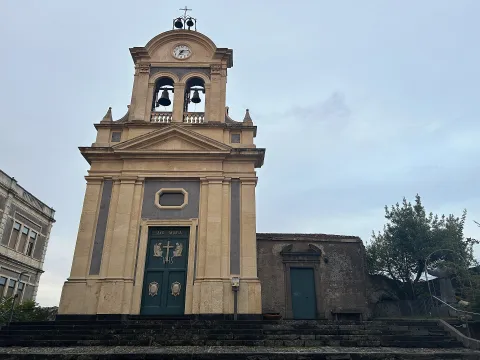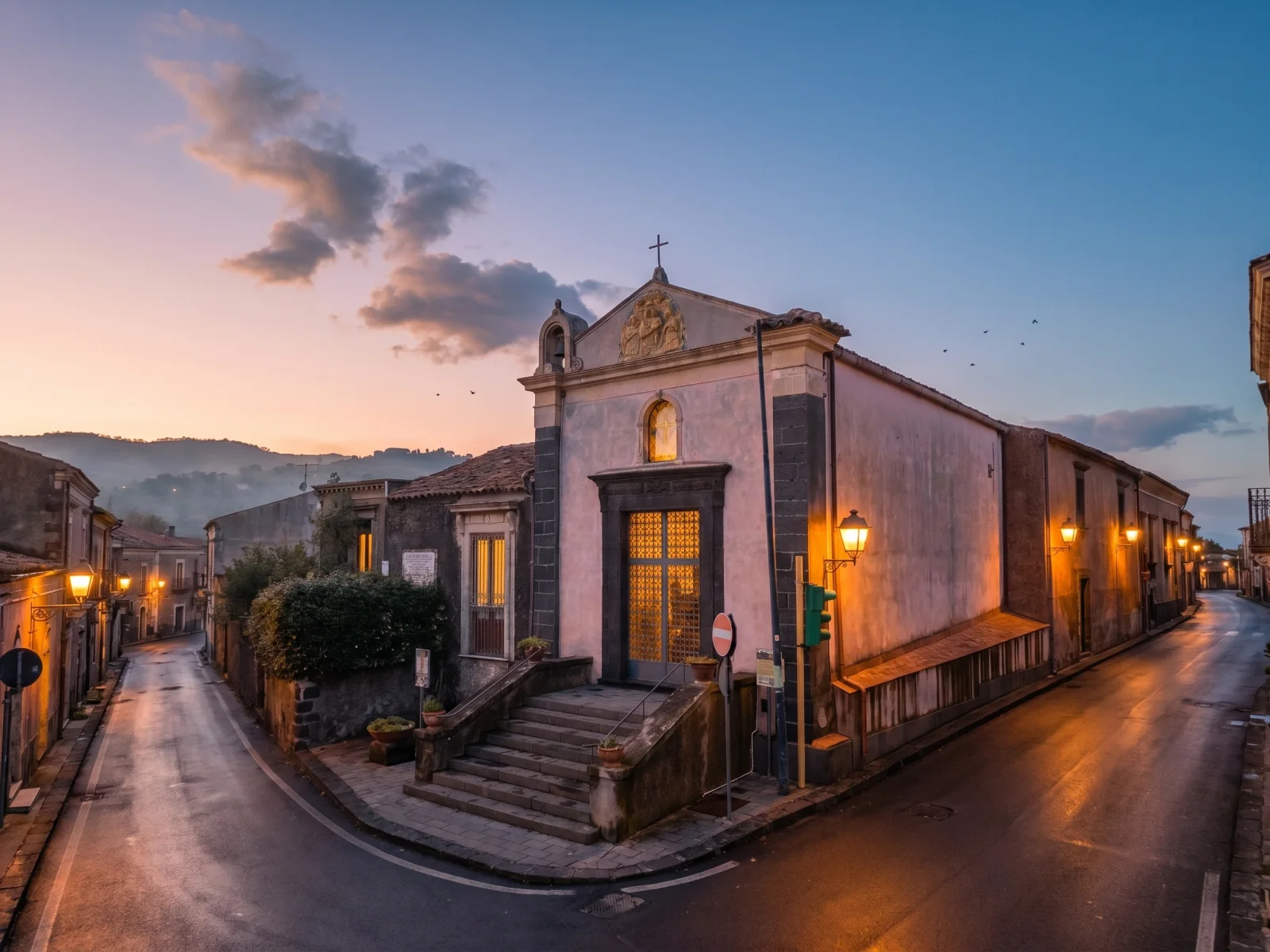
In Nicolosi, history is measured in lava flows, and the church of the Anime Santissime del Purgatorio — the Holy Souls in Purgatory — carries the marks more visibly than any other building in town. Etna's eruption of 1669 began on 8 March with a long series of earthquakes and only ended on 11 July, having effectively wiped out the village: the first mother church, dedicated to the Immaculate Conception, was buried under volcanic sand, while the inhabitants chose to stay out in the open at Falliche, west of the town.
The people of Nicolosi stubbornly refused to relocate to the new settlement of Fenicia Moncada, and around 1670-1680 the Prince of Campofranco, vicar of the Spanish king, granted them permission to rebuild on the original site. Both the mother church and the church of the Souls in Purgatory were raised again exactly where they had stood, reusing part of the material from the earlier buildings.
What to see
Read the building as a document rather than a monument: some of the stone in its walls belonged to the church destroyed in 1669, set back into place by survivors rebuilding their town on the very spot the volcano had erased. The reconstruction of the two churches was the first act of Nicolosi's rebirth — the village gained administrative autonomy in 1676 and in 1681, counting 844 inhabitants, became a self-governing community.
The centre around it preserves other chapters of the same story: the churches of Santa Maria delle Grazie, Madonna del Carmelo and San Giuseppe all date from the first half of the eighteenth century, when the resurrected town started growing again.
Visiting
The church stands in the centre of Nicolosi and the stop itself takes only a few minutes, so build it into a walk. Head for the crossing of via Martiri d'Ungheria and via Catania: beneath the present buildings still lies the first mother church of the Immacolata, buried by the sands of 1669. Few places in Sicily let you walk quite so literally on top of the previous town.
Our editors' tip
Finish on the Monti Rossi, the twin cones thrown up by that same 1669 eruption just outside town — the inhabitants first called them «Monti della ruina», the mountains of ruin. Looking down at Nicolosi from up there, knowing that the church's stones went through the catastrophe twice — first as rubble, then as building material — explains better than anything else why this town is called the gateway to Etna.