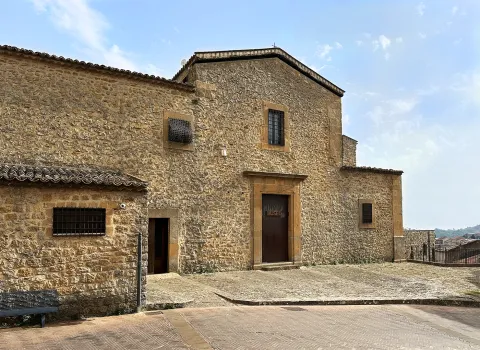
In 1979 a cult statue 2.20 metres tall vanished from the site: a limestone body, with face, hands and feet in marble. In 1988 the Getty Museum bought it for eighteen million dollars and called it Aphrodite. It came back to Sicily in 2011 and now stands in the museum at Aidone, two kilometres from the excavation, together with the polychrome terracotta head of Hades nicknamed Bluebeard, also returned by the Getty in 2016, and the Hellenistic silver of the Morgantina treasure sent home by the Metropolitan Museum of New York. Underneath those affairs lies a Sikel and Greek city: founded by the Morgetes on the hill of Cittadella, stormed and destroyed by Ducetius in 459 BC, reborn on the ridge of Serra Orlando, an ally of Agathocles in 317 BC, extremely rich under Hieron II, and finally besieged and levelled by the Romans in 211 BC.
What to see
The fenced area covers more than twenty hectares and preserves the Hellenistic town as it was between the 4th and the 1st century BC. Its centre is the agora, laid out on two levels: an upper square with porticoes on three sides, a lower one following the slope and, between them, the great trapezoidal stairway that links the two and doubled as seating for assemblies. The north portico of the gymnasium runs ninety metres. Around it lie the prytaneion, the ekklesiasterion, the public granary, the kilns for terracottas and the macellum the Romans planted in the middle of the square.
The theatre, dedicated to Dionysus, went from a trapezoidal plan to a horseshoe cavea between the end of the 4th and the beginning of the 3rd century BC; the sanctuary of Demeter and Kore next to it keeps its altars, its courtyards and the bothros, the pit for offerings to the gods below. The houses are the surprise: the House of the Doric Capital with its peristyle and a mosaic of welcome on the threshold, the House of Ganymede with a Hellenistic floor showing the abduction of Ganymede, the Pappalardo house with twelve columns round its courtyard. The monumental double-basin nymphaeum of the 3rd century BC was split open by what looks like an earthquake.
Visiting
Digging began in the autumn of 1955 with the Princeton University mission, and the site has not stopped being a research trench since. You come up from Aidone, on the road to Piazza Armerina: the car park sits at the foot of the plateau and the whole route is outdoors, on beaten earth, with slopes and no shade at all. Allow an hour and a half for the excavation, plus an hour for the Aidone museum, which has its own ticket and hours and stands in the village, in the former Capuchin convent. The two belong together, and in this order: the excavation first, the museum afterwards.
Our editors' tip
Start with the excavation even though the museum is the easier option: the goddess and the head of Hades say far more once you have just walked the plateau they were torn from. And stop for a few minutes at the top of the trapezoidal stairway, looking north over the Gornalunga plain and, on clear days, towards Etna: from there you can see why a city in the middle of Sicily could hold ten thousand people and mint its own coins.