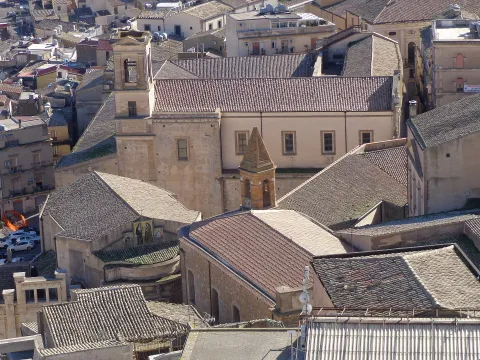
On 25 July 1090, the feast day of Saint James, Count Roger the Norman defeated the Saracens in the Valle del Conte just outside Caltagirone. In thanks he raised this church and placed the town under the saint's protection, and Caltagirone has venerated James as its patron ever since. The minor basilica of San Giacomo is among the oldest churches in the town, standing in the quarter that bears its name, west of the town hall along Corso Vittorio Emanuele.
What to see
The façade seen today belongs to the rebuilding that followed the Val di Noto earthquake of 1693, which levelled the church and spared only the chapels of San Giacomo and Santa Lucia; chronicles record that seven hundred worshippers at prayer died that day. The new building was entrusted to the Palermitan master Giuseppe Montes and the architect Simone Lo Mastro of Girgenti, who designed the front, while the Senate granted the considerable sum of 24,939 ducats. On the south side a portal rebuilt after the bombing of 1943 is the work of Giandomenico Gagini with Tommaso and Vincenzo Giarracca, dated 1611. The bell tower of 1889, by the architect Gaetano Coniglio, carries terracotta statues by Giuseppe Di Bartolo. Inside, three naves rest on twelve monolithic columns of dark marble quarried at Billiani near Trapani and raised in 1698, while the vault keeps the stuccowork of Giuseppe Fantuzzi of Barrafranca, finished in 1811.
Visiting
The basilica's treasure is the silver ark that holds the patron's relics, known simply as la cassa: a jointed sarcophagus worked over ninety-two years, from 1599 to 1691, by the Palermitan chaser Nobilio Gagini, son of Antonello, together with his own son Giuseppe and other masters from Caltagirone and Messina. Near it stand the wooden statue of the saint, carved by Vincenzo Archifel in 1518, and the processional float designed by Scipione Di Guido in 1589, originally silvered and gilded wood and recast in bronze in 1964. To the left, a white-stone portal by Antonuzzo and Giandomenico Gagini of 1583 is crowned by a stucco Annunciation; the Chapel of the Blessed Sacrament frames a great white-stone arch by Antonuzzo Gagini, dated 1586.
Our editors' tip
The town's devotion peaks on 25 July, when the ark and the float are carried out in procession — the best moment to grasp why the civic Senate handed the saint the keys of the city in 1743, still inscribed with the words URBIS CLAVES. Come at any other time and look on the rear of the front for the marble coat of arms of Caltagirone, carved by Giandomenico Gagini in 1600.