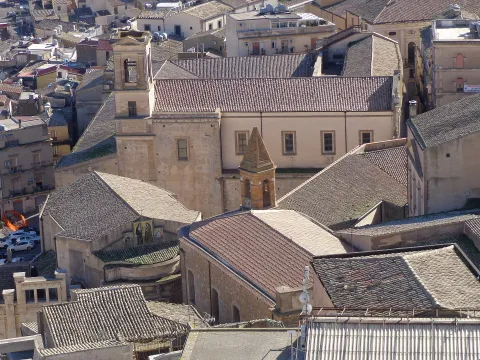
On 19 May 1894, in this octagonal church, Luigi Sturzo was ordained a priest and said his first Mass. Since 1962 his remains have rested here as well, and from the same building still echoes the appeal “to the free and the strong” with which the priest from Caltagirone founded the Italian People's Party. The church of the Santissimo Salvatore, paired with the former Benedictine convent beside it, forms a monumental cluster in the old center of Caltagirone. The nuns moved here in 1457, and the complex was rebuilt after the Val di Noto earthquake of 1693, most likely to a design by the local architect Nicolò Commendatore.
What to see
The Baroque front is organized around a central bay that answers the octagonal drum and dome above. Paired carved-stone pilasters with Corinthian capitals frame the main portal and the loggia window; the lintel, worked with scrolls and stylized acanthus leaves, carries the coat of arms of the Benedictine Order. Higher up, pierced belfry cells and a pediment topped by a wrought-iron cross close the bell-gable facade. Inside, the single octagonal hall is sheathed in dense stuccowork. The three marble altars are the work of the Catania sculptors Giovanni, Ignazio and Carlo Marino. In the left recess, the Chapel of the Madonna di Monserrato holds a marble statue carved by Antonello Gagini in 1532, while opposite it the Chapel of Saint Benedict houses an image of the saint from Norcia. On the polychrome-marble high altar hangs the Transfiguration of Christ, painted by Marcello Leopardi. The mausoleum of Sturzo was built in 1962 to a design by the architect Ugo Tarchi, with sculptures by Francesco Nagni: the sarcophagus, in yellow Siena marble, bears the figure of the sleeping statesman, flanked by allegories of Religion, Homeland, Liberty and People.
Visiting
Set off from the altars, four choir galleries of 1794, closed by finely carved and painted wooden grilles, recall the enclosure: from behind them the nuns followed the services unseen. For its works of art, and for the mausoleum in particular, the church has been placed under the Fondo edifici di culto, the Italian state fund for religious buildings. Part of its treasure — Gagini's Madonna di Monserrato, sacred silver made between 1731 and 1797 by Messina and Palermo workshops, the nuns' eighteenth-century wooden choir — is now shown at the episcopal palace of the Caltagirone diocese.
Our editors' tip
The open space in front of the church is also called Largo di San Domenico, after the church that faces it across the square, so a single stop takes in two places of worship. Look for the Benedictine crest on the portal before you step inside: it is the mark of the nuns who lived in enclosure for centuries behind those wooden screens.