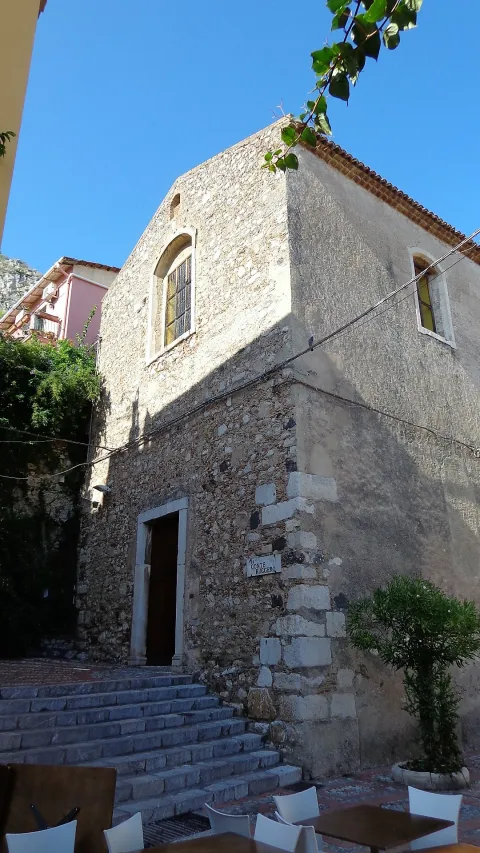
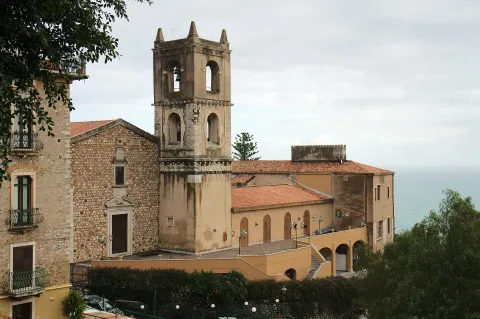
The Capuchin Friars Minor established their presence in Taormina in 1559, settling in what became the Cappuccini district on the site of an earlier Aragonese church dedicated to St. Catherine of Alexandria. The historic complex incorporates the Church of St. Anthony of Padua and its adjacent convent, where Saint Annibale Maria Di Francia founded a girls' orphanage in January 1902. Restored in 1964, the site belongs to the Archdiocese of Messina-Lipari-Santa Lucia del Mela.
What to see
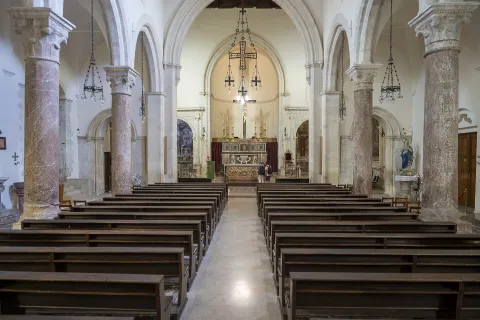
The interior features a wide single nave with altars along the right wall and three interconnected chapels on the left. The wooden high altar is crowned by an imposing oil painting executed around 1646 by the Capuchin friar Umile da Messina. The composition depicts the Virgin and Child flanked by St. Anne and St. Joseph, with a central angel presenting a model of Taormina to the Infant Jesus. In the lower section stand St. Pancras—painted using the likeness of the archdeacon Father Bonaventura—alongside St. Catherine of Alexandria, St. Francis of Assisi, and St. Dominic. The wooden tabernacle door bears the date 1780, and a small wooden pulpit with a wall-recessed staircase stands to the right of the altar.
The right wall holds a statue of St. Anthony of Padua and the tomb of Baron Filippo Sigismondo of Weitershausen, a German army captain killed at the Battle of Francavilla di Sicilia in June 1719. On the left, the Chapel of the Most Holy Crucifix displays a revered crucifix surrounded by depictions of the Sorrowful Mysteries and a painting of Three Capuchin Friars marking the 1638 martyrdom of Agatangelo da Vendôme and Cassiano da Nantes. The adjoining chapels include an ossuary marked with the year 1596 and a canvas showing St. Lawrence healing a blind man.
Visiting
The sanctuary holds deep ties to civic history, most notably through its miraculous crucifix. During the Mount Etna eruptions of 1693 and 1780, citizens, clergy, and magistrates carried the sculpture in penitential procession to the monastery of Santa Maria di Valverde in Piazza Badia to pray for rain and relief from earthquakes. Inscribed floor slabs marking common ossuaries and 19th-century tombs remain accessible throughout the chapels.
Our editors' tip
When examining the 1646 altarpiece by Umile da Messina, look closely at the central register: the angel on the left holds a detailed miniature representation of 17th-century Taormina up to the Christ Child.