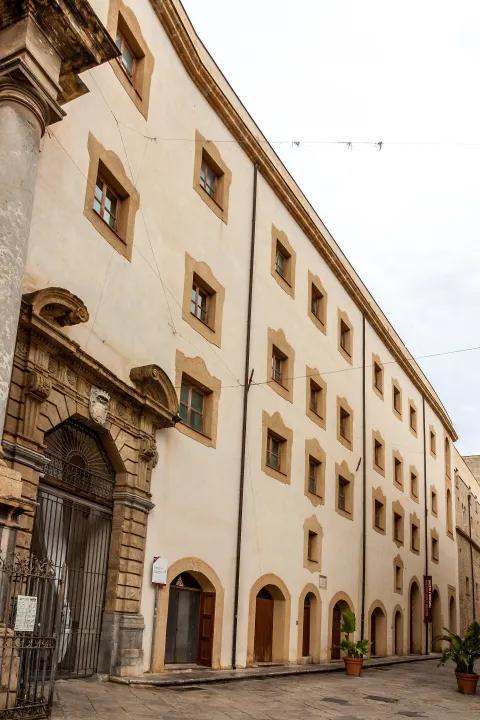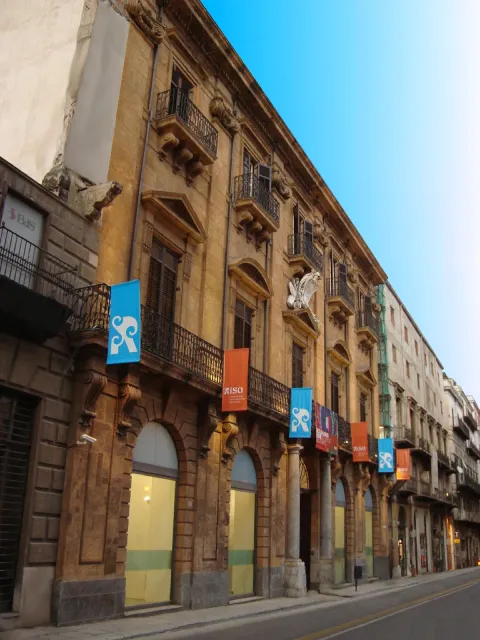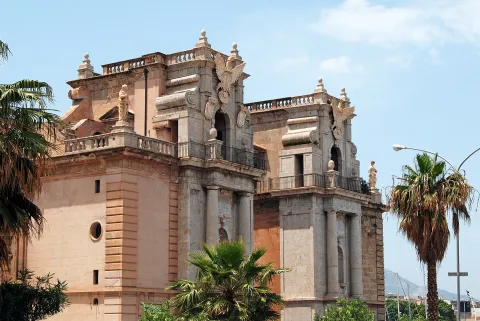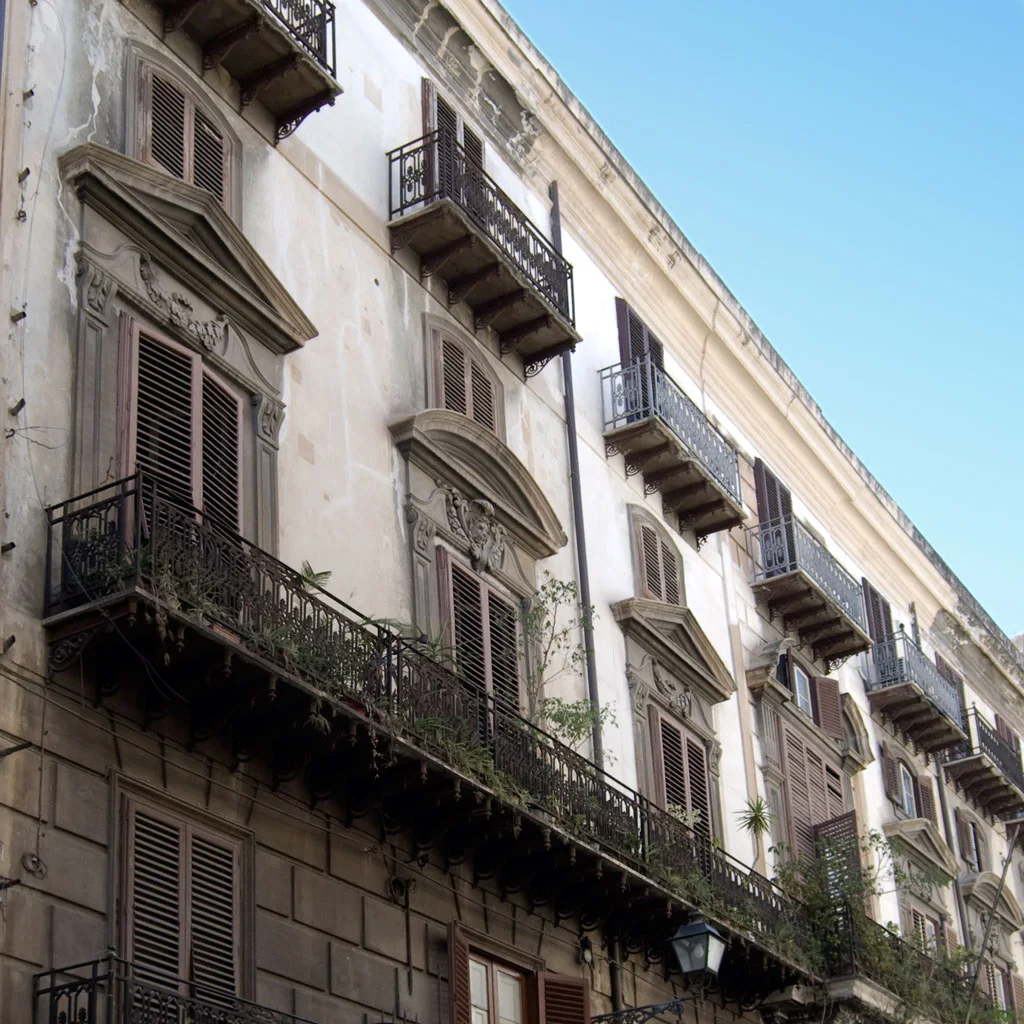
This palace was dismantled from the inside. In the twentieth century the grand staircase was demolished to make room for a block of flats' stair, the main portal on the Cassaro was walled up to make a shop, and the entrance was moved to the side door that used to lead into the stables. Of the monolithic columns in the courtyard one is still visible: the other ended up inside a wall.
What to see
The first nucleus was raised in the sixteenth century by a baron of Pettineo. From the middle of the eighteenth century the palace belonged to Vincenzo Termine, count of Isnello and prince of Baucina, who commissioned its enlargement from an architect who has remained unknown: the building swallowed six pre-existing medieval houses, of which traces remain, and was completed in 1750. The front on the Cassaro is post-Baroque and already anticipates neoclassicism, on three orders, with the main floor crossed by a single balcony of seven openings, triangular and curved pediments and dormers above. The portal opened between two monolithic Tuscan columns of African marble, under an architrave with triglyphs, acanthus leaves and lion masks.
On the main floor are frescoes by Vito D'Anna and Francesco Sozzi, among them the Apotheosis of Palermo, a masterpiece of Sicilian rococo and one of the eight historic depictions of the Genius of Palermo. In the nineteenth century the historian and Arabist Michele Amari lived here, until in 1843 the autonomist ideas he set out in his essay on the war of the Vespers made him unwelcome to the Bourbon government and he had to go into exile in France. Then, from 1929, the new owners remade the building to suit themselves. The wartime bombing damaged it, an earthquake in the early two-thousands required structural consolidation, and on the via Isnello front there is a plaque remembering Amari.
Visiting
The palace is between the Cassaro and piazza Borsa, at the northern edge of the Kalsa. It is a private building, divided among several owners, and cannot be freely visited: the fronts are looked at from the street. A quarter of an hour, from outside.
Our editors' tip
Stand on the Cassaro and find the two African marble columns at the centre of the front. Then look at what is between them now: a shop window. That was the main door. The palace still has its face, with the architrave, the acanthus and the masks all in the right place, but the door does not open any more, and for a century people have gone in on the side where the horses were kept.