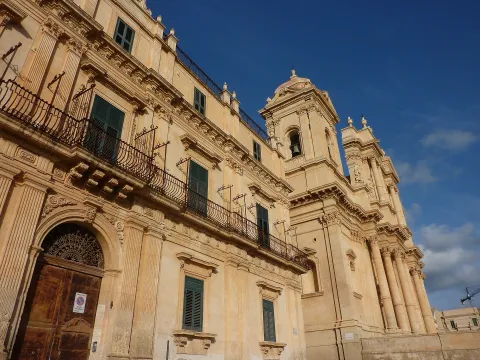
The palace has 105 rooms spread over 5,000 m², figures that make it one of the largest noble residences in the Val di Noto. When the last marquis, Corrado Di Lorenzo, died in 1981, the building passed by bequest to the Order of Malta, which held it for some thirty years without living in it. It was put back on its feet by a French businessman, Jean-Louis Remilleux, who bought it in 2011 and, once the restoration was finished, opened it to the public in 2018.
What to see
The façade at via Cavour 10 is the first surprise: in a town rebuilt entirely in Baroque after the earthquake of 1693, the marquis Corrado Di Lorenzo del Castelluccio had a neoclassical palace built for himself in 1782, modelled on the Roman houses then in fashion. The family name comes from the fief of San Lorenzo, between Noto and Pachino; the title from the fief of Castelluccio, a few kilometres out of town. Between the late 18th and the early 19th century a marriage to a descendant of the Borgia split the house into two branches, the Di Lorenzo Borgia del Casale and the Di Lorenzo Borgia del Castelluccio: it was the latter who moved in here.
You enter through the main courtyard, with reliefs in Noto stone recalling the family's ancestors at Noto Antica, two carved palms as a sign of wealth and two symmetrical staircases climbing to the piano nobile. Upstairs the rooms run in an enfilade — vestibule, ballroom, music room, ceremonial drawing room — with neoclassical frescoes on walls and ceilings. The other half of the building belongs to work: the old kitchens, the cellars, the servants' dining room, the stables and the carriage house.
Visiting
Entry is accompanied and by booking, with a ticket: hours change with the season, so check them before turning up at the door. The courtyard and the piano nobile take about an hour; add the kitchens and the stables and you comfortably reach an hour and a half. Via Cavour is one of the upper streets of the old town, a short walk from corso Vittorio Emanuele and the cathedral: the whole historic centre of Noto has been a UNESCO site since 2002, as part of the late Baroque towns of the Val di Noto. The palace now belongs to the Rocco Forte hotel group.
Our editors' tip
Do not rush the service quarters: the kitchens, the cellars and the stables explain how the house actually ran far better than the ballroom does, and they are usually crossed at speed. Anyone who watches Italian drama will recognise more than one room, since the palace has been a set for Il commissario Montalbano among others, and there is a documentary devoted to it, Poco Noto - Lettere dal Palazzo. The restoration was above all conservative: look at the floors, the doors and the wall colours, they are what was found here.