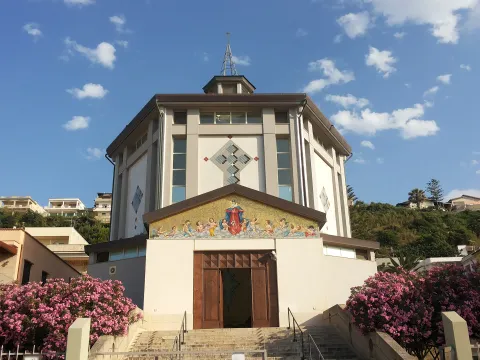
The church of San Francesco d'Assisi in Alcamo belongs to the Fondo edifici di culto. Tradition says it was built between 1224 and 1226 by the Blessed Angelo Tancredi of Rieti, a companion of Saint Francis, but the document by which it passed to the Sicilian Franciscan province, sealed by Pope Clement VI, dates from 1348. Rebuilt between 1379 and 1380, from the sixteenth century it gave its name to one of the town's four historic quarters; between 1608 and 1648 it was demolished and rebuilt together with the friary, and in 1716 it was enlarged and embellished.
What to see
The interior has a single nave with a barrel vault, eight altars and the side chapel of the Immaculate Conception; the bell tower and doorway are the parts that remain as in the original design. On the high altar is Andrea Carrera's canvas of 1677 showing Saint Francis asking for the Portiuncula indulgence. Among the sculptures stand out two marbles by Antonello Gagini of 1520, Saint Mark and Saint Mary Magdalene, whose base bears the arms of the Scalisi family who commissioned it, and a marble altarpiece with the Madonna and Child considered a probable work of Giacomo Gagini, from 1568.
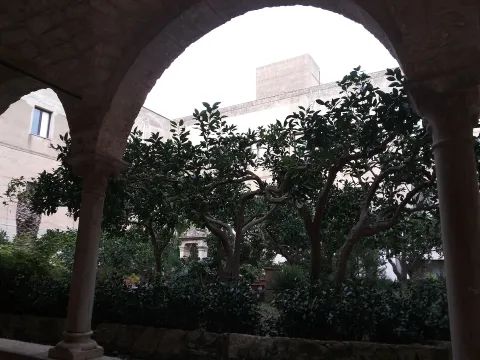
In the chapel of the Immaculate Conception are Giuseppe Carrera's painting of the Immaculate of 1610, restored in 1980, and the wooden statue of the Immaculate carved in 1695 by Ignazio Ingrassia of Trapani. Next to the church are the Franciscan cloister and the oratory of the Compagnia dell'Immacolata, founded in 1596, with a canvas by Nicolò Pizzitola of 1888. On the right side of the apse a seventeenth-century canvas shows Our Lady of Mercy.
Visiting
The Conventual Franciscans stayed in Alcamo from 1348 to 1866 and returned in 1962; the church has been a parish since 1969. After the Belice earthquake of 1968 church and friary were restored between 1975 and 1976. Mass and opening times should be checked with the diocese of Trapani.
Our editors' tip
Until 1884 the chapel of the Immaculate held 34 paintings of saints, added in 1613 by the brothers of the Compagnia dell'Immacolata, each of whom had his own name written on one.