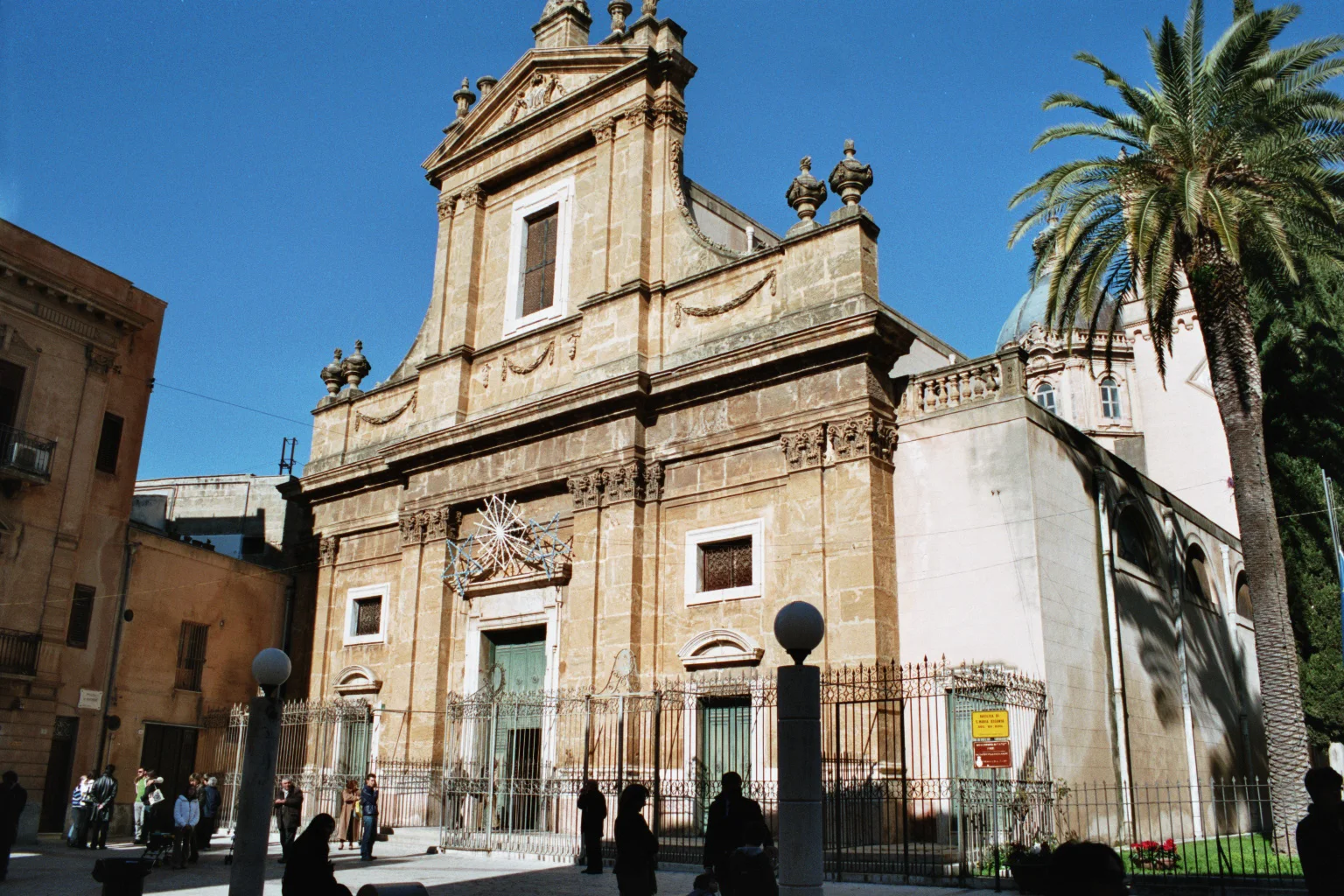
The basilica of Santa Maria Assunta, Alcamo's mother church, stands right in the centre, a few steps from piazza Ciullo. In 1332 the people of the San Vito quarter moved near the castle, and a new mother church dedicated to the Assumption was built here, opened for worship in 1402, in Catalan Gothic style with three aisles. Of that building the bell tower with two-light windows, the chapel of the Holy Thorn and the baptismal font survive. The church was rebuilt in 1699 by Giuseppe Diamante and Angelo Italia; the neoclassical façade dates from 1786, by Emanuele Cardona to a design by Francesco Alessandro. In May 1969 Paul VI raised it to minor basilica.
What to see
The interior has three aisles divided by columns with monolithic shafts of red marble from nearby Monte Bonifato, stuccoes by the Curti family and a floor designed by Giuseppe Patricolo. The vaults and chapels carry 38 frescoes by Guglielmo Borremans: the three on the vault, from 1735, show the Assumption, the Coronation of the Virgin and the Madonna as Queen between Saints Peter and Paul.
There are many sculptures by the Gagini: Antonello Gagini's marble altarpiece of 1519 in the chapel of the Privilegio, the Crucifix of Abundance made by him between 1519 and 1523, the relief of the Dormition of the Virgin of 1529, the baptismal font and the gilded marble Saint Peter by Giacomo Gagini of 1586. In the apse are the Assumption of 1605 attributed to the Fleming Franz van Castel and the wooden choir of 1748; in the chapel of the Madonna dei Miracoli is Lorenzo Curti's wooden statue of 1720, carried in procession in June. The chapel of Saint Francis keeps a late fourteenth-century fresco of the Madonna della Neve.
Visiting
A door in the left aisle leads to the sacristy and the Museum of Sacred Art. The chapel dedicated to Don Giuseppe Rizzo is a modern work by Paolo Portoghesi, opened in 1995. Mass and opening times should be checked with the diocese of Trapani.
Our editors' tip
In the chapel of the Holy Thorn a silver reliquary of 1636 holds a thorn that, the story goes, Charles V brought to Alcamo in 1535: of the three thorns that arrived, the bishop of Mazara had them all burned and only this one remained intact.


