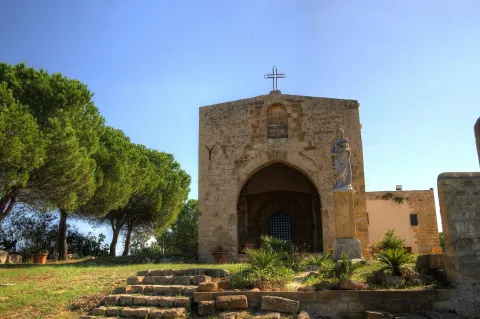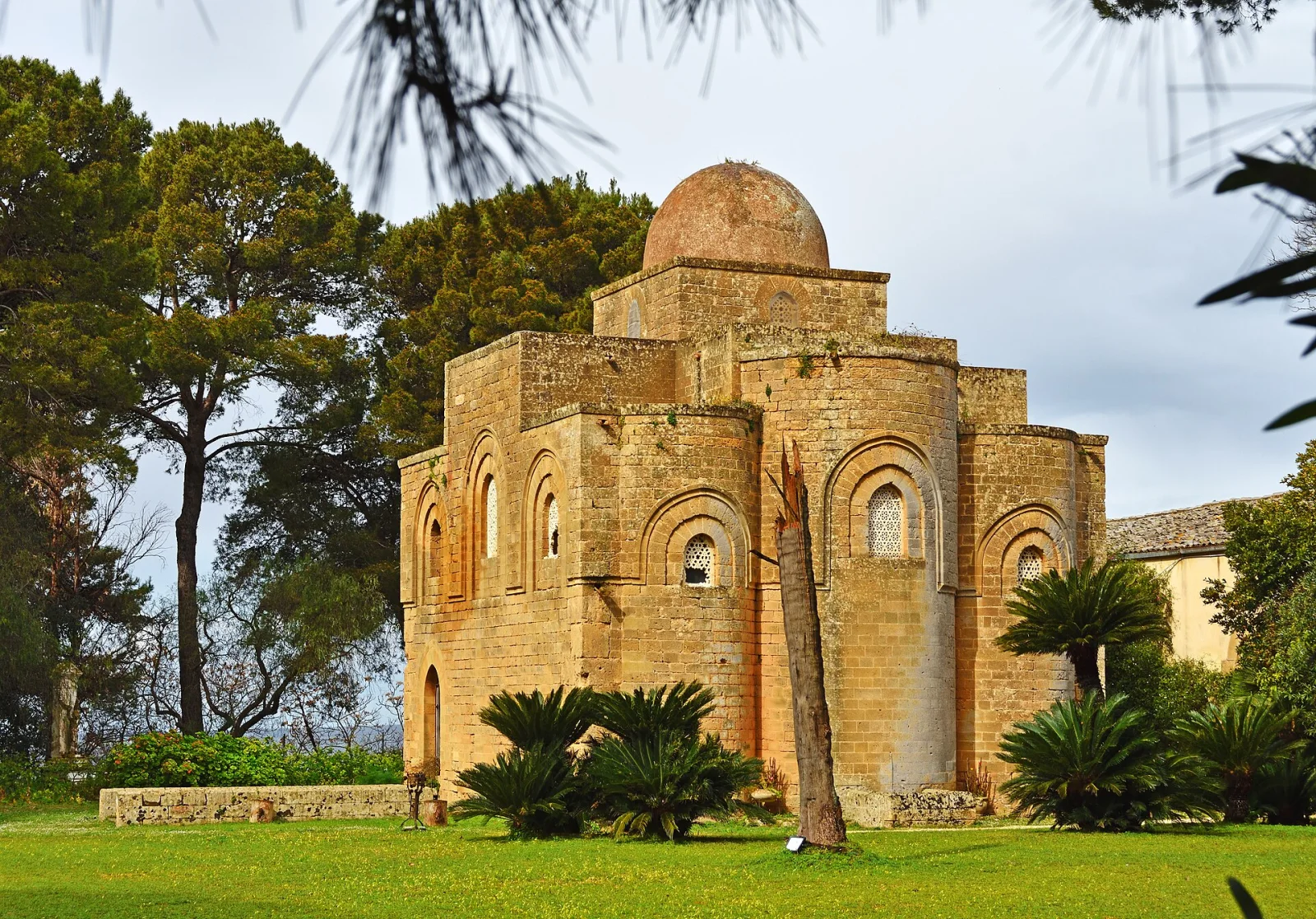
In open country west of Castelvetrano stands a small Norman church built on the model of the Byzantine cuba, in the first half of the twelfth century. From outside you see the three apses projecting east and, on the other side, the three doors that correspond to them; and those three doors were not equivalent, because each served a different group of people.
What to see
The side doors were reserved for men, who on entering took their places in the corresponding side aisles; the central door was for women, who according to the Greek rite stayed in a zone marked off by wooden screens. The building, in short, has a social rule written into its plan, and it is the most direct way to understand how people stood in church then.
At the centre rises a dome on a square drum, with four windows and pointed arches resting on reused ancient columns, in cipollino marble and red granite, with acanthus capitals. The arms of the cross are barrel-vaulted, the corners groin-vaulted. In the nineteenth century a local family restored it and made it their burial chapel as well.
Visiting
The church is a few kilometres from Castelvetrano, among the olives near an artificial lake, and is reached only by car; opening is not continuous and depends on the custodians, so it is worth asking in town before setting out. Half an hour.
Our editors' tip
Before going in, stop in front of the three doors and ask yourself which one you would have used. It is a banal question and it changes everything: that building is not only a fine shape in the middle of the fields, it is a device that decided where each person had to stand, and its beauty is the consequence of that.