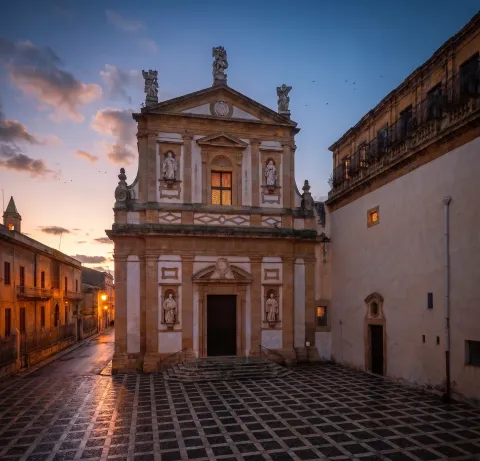
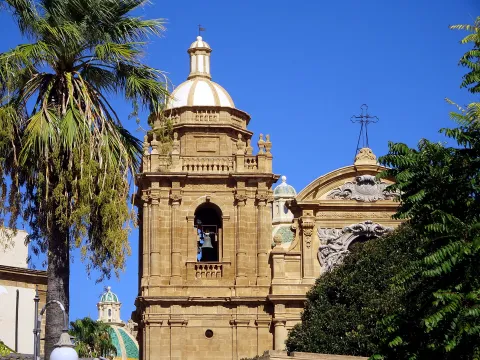
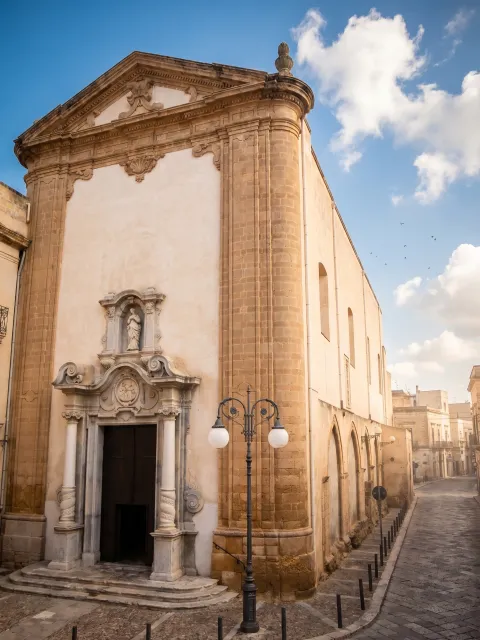
Count Roger I of Hauteville founded it in 1072, just after wresting Mazara del Vallo from Arab rule: the Royal Abbey of Santa Maria dell'Alto — known to locals as Madonna dell'Alto, or Madonna delle Giummare — began as a Byzantine-Norman church entrusted to monks of the Greek rite. A charter of King Roger II, dated 1145, records it as S. Maria de Mazara and placed it under the Archimandritate of the Most Holy Saviour in Messina; from 1567 to 1811 it was a commandery of the Knights of St John of Jerusalem.
What to see
Centuries of damage and rebuilding have not erased the original plan. The façade is marked by a porch, or protiro, with two pointed arches opening on its left wall, while the portal dates from the 14th century. Inside, the Byzantine liturgy is still legible in two side niches — the prothesis to the north, the diaconicon to the south — holding two original frescoes, one badly mutilated, of St Basil and St John Chrysostom. The large central niche frames a marble statue of the Madonna and Child signed “Iacobi Castegniola manu,” which scholars read as the work of the sculptor Giacomo Cassignola. The furnishings include a silver censer with its incense boat and a monstrance, both bearing the arms of the Burgio and Riggio families alongside the Maltese cross, a memory of the church's long Hospitaller chapter.
Visiting
Several objects once kept here now live elsewhere in town. A Roman urn, still serving as a basin in 1876, passed to the Cathedral of Mazara del Vallo, while a plain Corinthian capital hollowed out into a holy water stoup, and the small column that held it, are preserved in the Diocesan Museum. In 1873 the church was ceded to the diocese on the express condition that it stay open for worship, and so it has.
Our editors' tip
Pause under the porch before you step in and look for the two pointed arches on the left wall: they are the clearest trace of the Norman foundation. Then, anyone chasing the abbey's full story should budget two extra stops — the Cathedral for the Roman urn, the Diocesan Museum for the holy water stoup — since part of its heritage has ended up there.