On the nave vault the devil is caught mid-escape: in the fresco of the Triumph of Saint Michael over Lucifer, part of Lucifer's figure juts out beyond the painted surface, as if trying to slip out of the scene. It is the strangest detail in the church of San Michele in Mazara del Vallo, a Baroque building commissioned by George of Antioch in the 12th century and rebuilt in the early 1600s at the wish of abbess Ausilia Lazzara. Bishop Giuseppe Cicala consecrated it on 23 January 1678, an event recorded by a plaque set just inside the entrance.
What to see
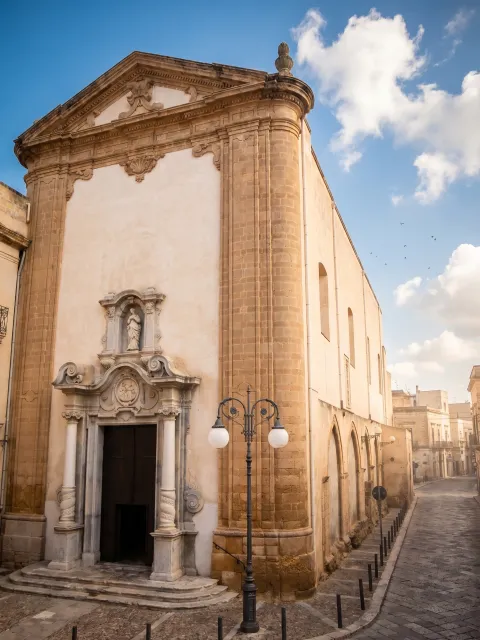
The facade, Neo-Renaissance in taste, was built in 1702 by Alberto Orlando: two stacked orders, Doric capitals below and Ionic above, and four niches holding statues of saints Bernard, Benedict, Scholastica and Gertrude. At the top of the triangular pediment sits a Saint Michael the Archangel carved by Fazio Gagini. Inside, the church has a single nave under a barrel vault, a short transept and a deep apse; a hemispherical dome rises over the crossing on a cylindrical drum. Twenty white stucco statues by Bartolomeo Sanseverino line the walls, while the frescoes and canvases are the work of Tommaso Maria Sciacca, who painted the Massacre of the Innocents, the Holy Family, the Death of Saint Benedict and, on either side of the presbytery, Abraham and Melchizedek and the Supper at Emmaus. Look for the triptych-shaped ciborium signed by Antonello Gagini in 1532 and the main cantoria built between 1696 and 1702 by Natale Pugliese. The interior stuccoes date to 1697 and were gilded in 1764 under abbess Maria Benedetta Gerbino.
Visiting
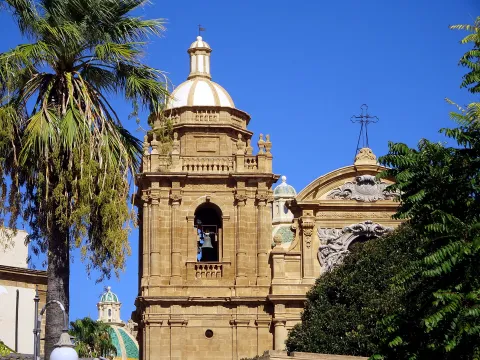
Through the transept the church connects with the adjoining Benedictine monastery, recognisable by its loggia of twelve windows fitted with bulging iron grilles: from there the nuns followed the ceremonies held in the square outside. Beside the monastery front stands the 18th-century bell tower, with a tall base, a square body carrying a clock on three sides, an octagonal storey and a small turret topped by a cupola. A guesthouse is also attached to the church, brought back into use for the Jubilee of 2000. Among its furnishings the church keeps the silver statue of Saint Vitus, carried through the streets each year during 'u fistinu di Santu Vitu.
Our editors' tip
Before you leave, look up at the vault and find the spot where Lucifer's figure breaks free of the fresco's plane: it is an illusionistic trick you catch best by viewing the scene at an angle, moving toward the presbytery. If you reach Mazara during the days of the San Vito festival, the silver statue leaves the church and can be met along the streets of the town.