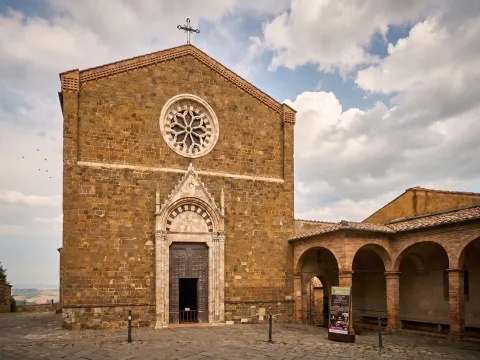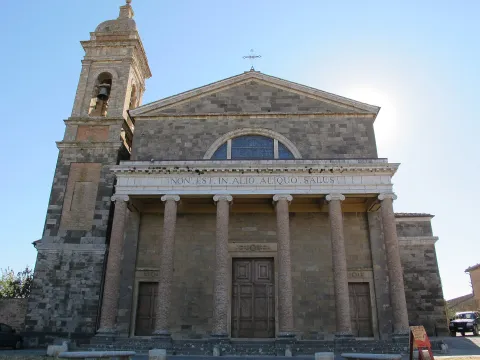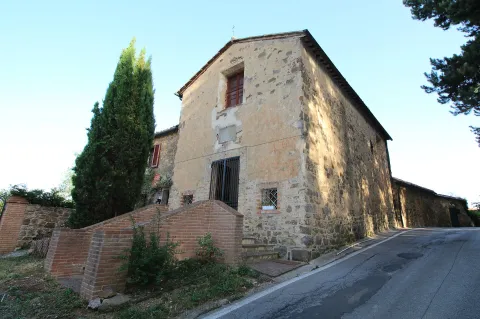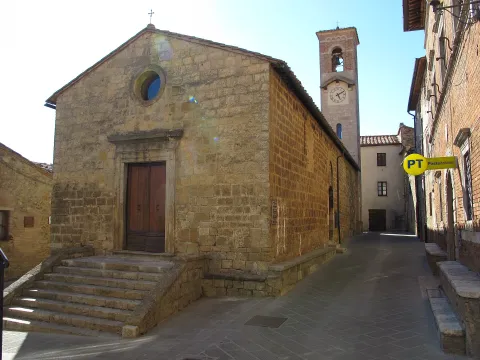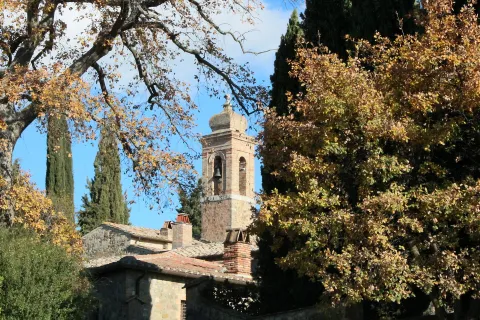
The pieve of San Giovanni Battista faces the main square of San Giovanni d'Asso, a village in the Crete Senesi that today belongs to the commune of Montalcino. Building began in the early fourteenth century, after the Petroni family bought the local castle, and the church was consecrated in 1323. In 1492 it replaced San Pietro in Villore as the parish church, and in 1539 it was raised to the rank of pieve, gaining a baptismal font of its own.
In 1639 the Pannilini family, who had taken over its patronage, rebuilt it so thoroughly that it was reconsecrated on 5 June of that year; further works followed in 1879. The most radical intervention came in 1973, designed by Costantino Ruggeri and Luigi Leoni: the black-and-white striped decoration of the walls was removed and a new presbytery was created, dedicated on 1 January 1974 by bishop Renato Spallanzani.
What to see
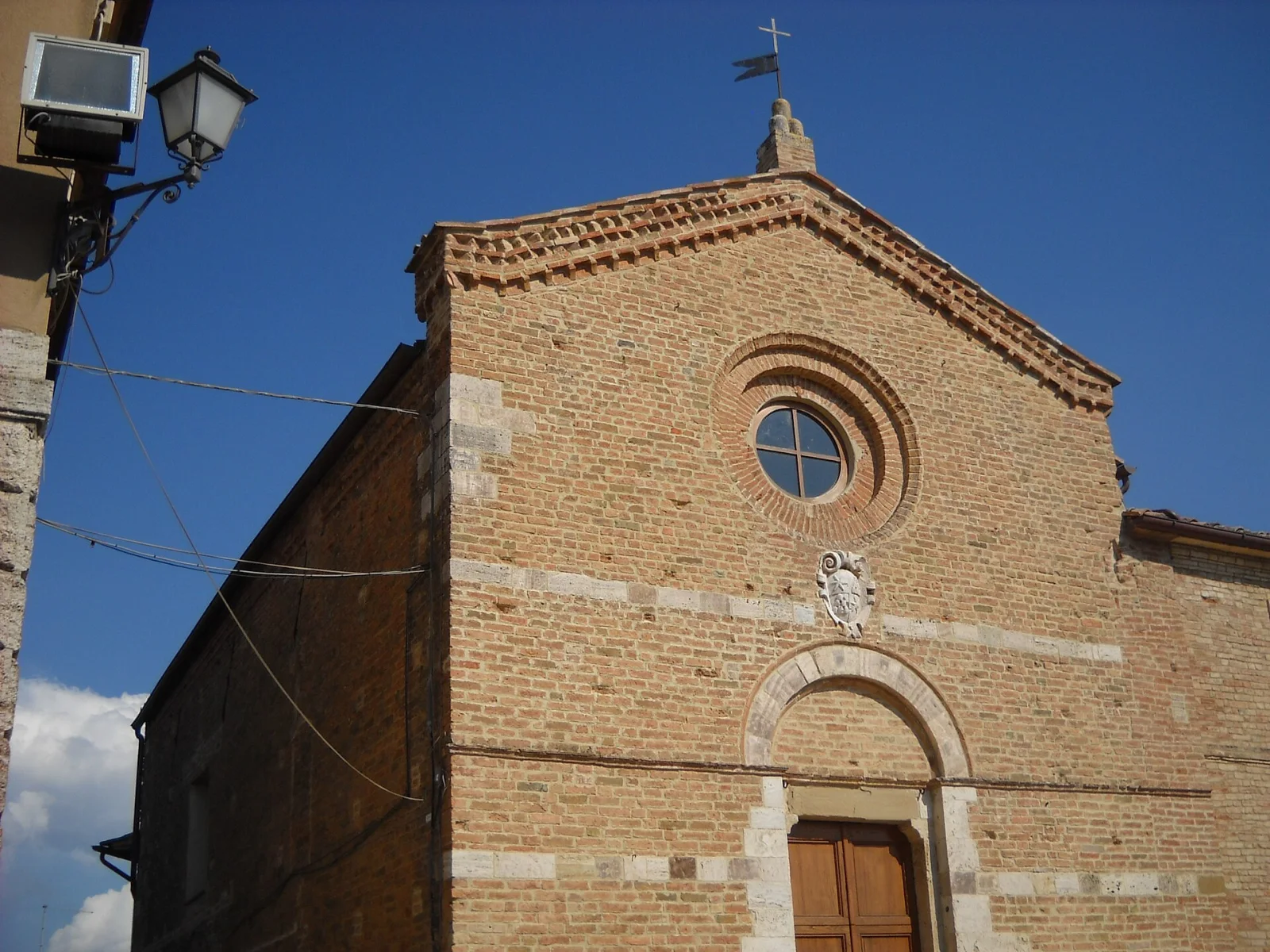
The gabled brick facade, crossed by three stone bands, combines a portal below and a circular rose window above; a bell gable with two bells rises at the far end of the nave. Inside is a single nave of three bays divided by two round arches, with no apse. The first bay on the left holds the sixteenth-century font; the second a painted wooden Crucifix and a Madonna of the Rosary attributed to Girolamo Cerretelli, from the 1610s.
The most unusual piece sits above the stone presidential seat: an eighteenth-century altarpiece frame with a two-door cabinet containing the relics of thirty saints, among them Peter the Apostle, Catherine of Siena and John the Evangelist, topped by a Baptism of Christ from the school of Rutilio Manetti. To the right stands the old polychrome wooden tabernacle.
Visiting
The church itself takes little time; linger over its newest arrival, though. Since 2025 it has housed a Dargassies-Gonzales organ built in 1990 for a private home in Paris and moved here by organ builder Enrico Barsanti: 19 stops over two manuals and pedal, entirely enclosed in a swell box. It replaced the Pinchi opus 337 organ, which stood here between 2016 and 2018.
Our editors' tip
If you can pick your date, come on the Saturday before the first Sunday after Easter, when the village celebrates the "scricchio". The seventeenth-century cabinet holding the relics donated by cardinal Riccardo Petroni is opened, one saint is drawn by lot to be carried in procession the next day, and when the doors close again their creak — the scricchio — is read as a good omen for the year's harvest. At any other time of year, pair the pieve with nearby San Pietro in Villore, the older parish church it replaced in 1492.