On August 13, 1462, Pope Pius II elevated Montalcino's 11th-century Romanesque parish church of Santissimo Salvatore to cathedral status. That original medieval structure was entirely demolished starting in 1817 to make way for the current Neoclassical co-cathedral, designed by Sienese architect Agostino Fantastici and consecrated on April 24, 1864, by Bishop Giovanni Bindi Sergardi. Designated an Italian national monument, the church became a co-cathedral of the Archdiocese of Siena-Colle di Val d'Elsa-Montalcino in 1986.
What to see
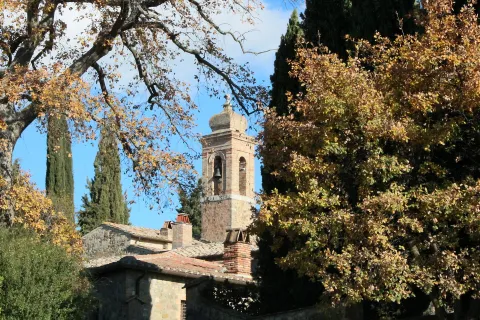
The exterior features a tall pronaos supported by six brick Ionic columns topped with marble capitals, fronting the town's oldest square. Standing slightly apart on the left is the 18th-century bell tower, erected alongside the original Romanesque cathedral before its 19th-century reconstruction. Inside, the Neoclassical layout includes three aisles separated by Ionic colonnades and a double transept layout. The eastern transept against the front wall contains two paintings by Francesco Vanni: an Immaculate Conception from 1588 and Saint John the Baptist in the Desert from the 1580s. Plaster statues of Saint Michael the Archangel and Saint John the Evangelist, sculpted in 1842 by Antonio Rossi, stand in niches along the central nave. Inside the baptistery, visitors can view a 1933 travertine font by Egesto Bellini along with surviving 11th-century Romanesque relief fragments showing Christ in a mandorla flanked by incense-bearing angels. The presbytery holds a high altar designed by Fantastici between 1828 and 1832, a 16th-to-17th-century wooden bishop's throne, and 19th-century choir stalls. In the left arm of the western transept sits a mechanical organ built in 1858 by Nicomede Agati (opus 453). The sacristy and Suffragio chapel house a 1647 altarpiece by Francesco Nasini and late 16th-century Sienese school paintings.
Visiting
Located on the main cathedral square in the historic center of Montalcino, the co-cathedral offers public access to its Neoclassical interior, side chapels dedicated to Saint Joseph and the Virgin Mary, the baptistery, and the presbytery housing Fantastici's high altar.
Our editors' tip
When entering the baptistery at the start of the left aisle, look closely at the left wall to inspect the 11th-century Romanesque relief fragments depicting Christ in a mandorla—the only carved remnants saved from the medieval church prior to its 1817 demolition.