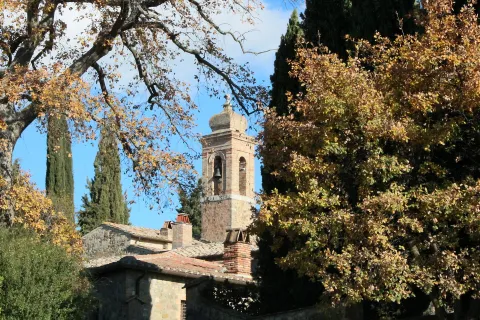
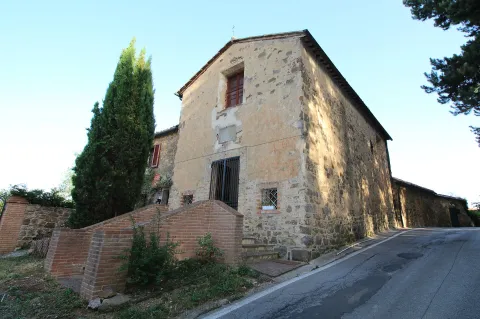
Castelnuovo dell'Abate, a hill village in the commune of Montalcino, is known above all for the abbey of Sant'Antimo in the valley just below. The village's own parish church, the pieve of Santi Filippo e Giacomo, deserves a stop in its own right. Originally dedicated to Saint John, it took its present title in the early fifteenth century.
From the outside it gives little away: its real assets are two frescoes by one of the leading Sienese painters of the late sixteenth century.
What to see
Both frescoes are by Ventura Salimbeni (1568-1613), a Sienese master of late Mannerism. On the counter-facade — the wall behind you as you enter — is the Martyrdom of Saint Catherine of Alexandria; in the lunette of the side portal, a fresco dated 1597 depicts the Blessed Pietro Petroni, a fourteenth-century Carthusian monk from Siena. Everything else inside dates from 1938, when the church was redecorated in neo-Gothic style, so the two late-Renaissance paintings now sit within a distinctly modern frame.
Visiting
The church stands in the centre of the village and a visit takes little time. Look for the frescoed lunette above the side portal before you go in, then turn around once you have crossed the threshold: the Martyrdom occupies the least obvious wall of all, the one you just walked through. Afterwards, the stone lanes of Castelnuovo dell'Abate make for a short stroll, with views dropping towards the abbey valley.
Our editors' tip
Most visitors drive straight to Sant'Antimo and never climb up to the village. Do the opposite: park in Castelnuovo dell'Abate, see the pieve first, then walk down towards the abbey, which appears below the village among the olive trees — the sequence works far better than the reverse. And note the date on the lunette, 1597: within a few years Salimbeni would become one of the most sought-after painters in the churches of Siena, yet here you meet his work in a country parish church, with no ticket and rarely a crowd.