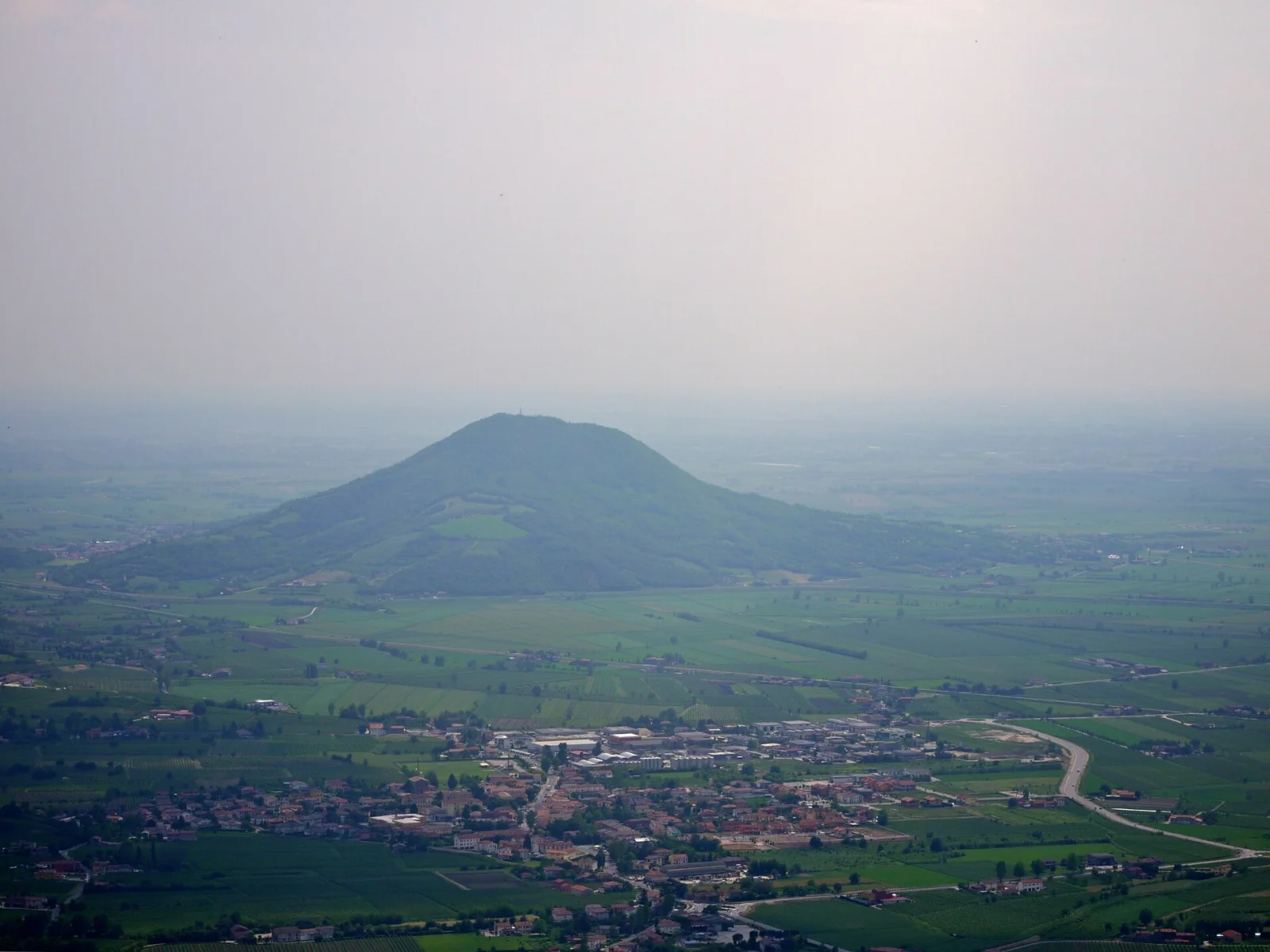
Together with Ne and Re it is the comune with the shortest name in Italy, and that name is a ford: it comes from the Latin vadum, which also means «marsh, shallows», by way of the form vao. The ford, however, lay on a river that no longer passes this way. Before the disastrous flood known as the rotta della Cucca, in 589, a branch of the Adige broke off a little above Este, skirted the whole chain of the Euganean hills and rejoined the main course near what is now Bovolenta; in ancient times the settlement was called Vicus Euganeus. The village itself has moved too: at the beginning of the twentieth century the town hall was transferred to Ca' Erizzo, in a more central position, and today's Vo' grew around that seat, while the old centre — which had formed around the villa the Contarini had built in the seventeenth century — was renamed Vo' Vecchio. At Zovon the trachyte quarries are still working, a stone that resists the weather and was used in antiquity for columns, paving and flights of steps.
Two dates weigh on this village of a few thousand people. In the villa Contarini Giovanelli Venier at Vo' Vecchio, from the third of December 1943 to the middle of July 1944, the Italian Social Republic kept one of its concentration camps for the Jews of the Padua and Rovigo districts, who were then deported to Auschwitz: at the moment of deportation forty-seven people were interned there. In February 2020 Vo' was instead one of the first outbreaks of the pandemic in Italy; the whole population of the comune was swab-tested, and the study led by Andrea Crisanti, professor of microbiology at the university of Padua, brought out the fact that the virus could also be transmitted by people who were infected but had no symptoms.