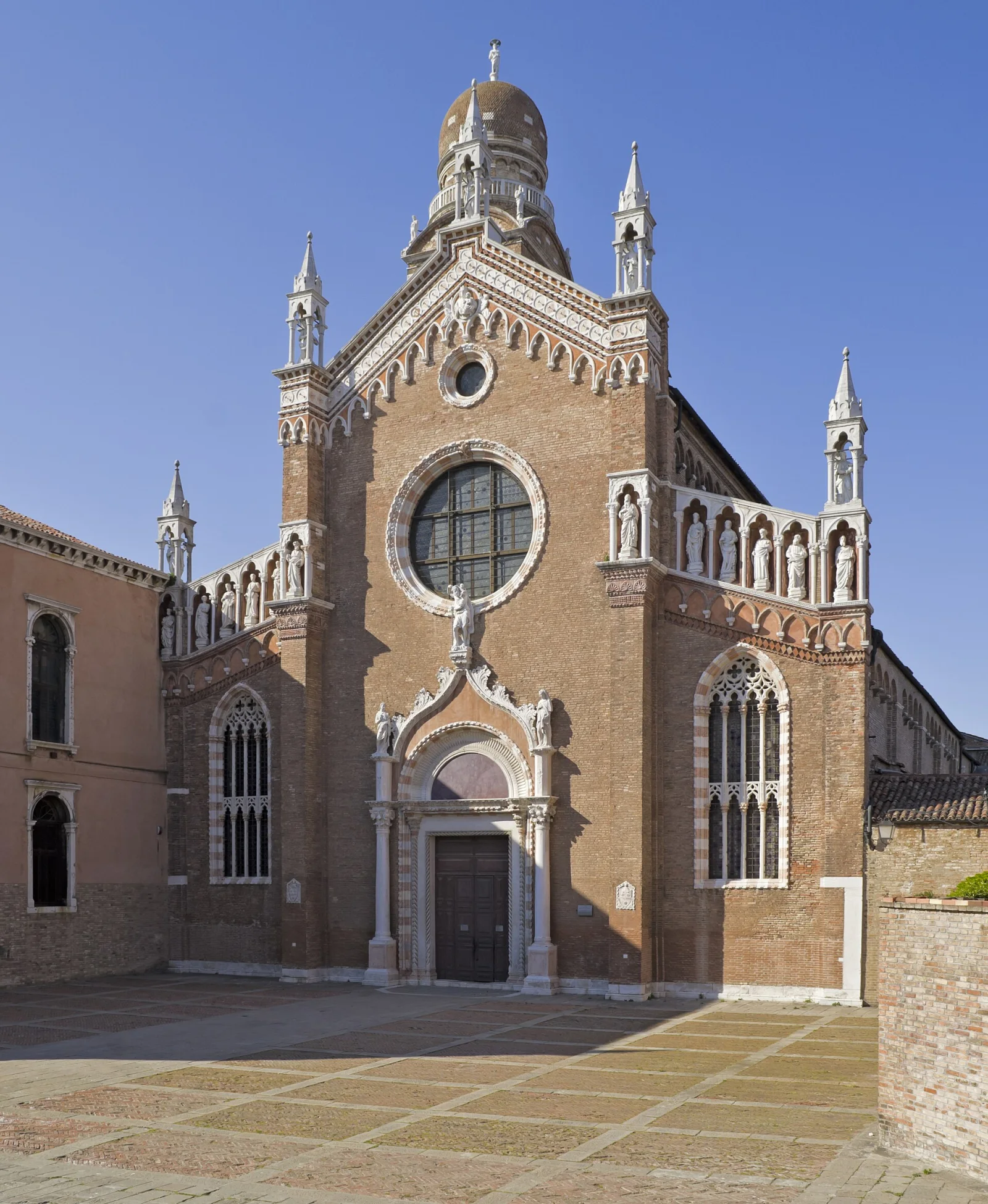
This church is dedicated to Saint Christopher, but nobody calls it that. Its real name was given by the people, because of a statue of the Virgin that a sculptor, Giovanni De Santi, had left unfinished in the vegetable garden of his house after the client refused it. His wife swore she had seen it glowing in the night; the neighbourhood began coming on pilgrimage, and the friars bought it for 150 ducats. On 18 June 1377 the Madonna of the garden entered the church and gave it the name it still bears. Three hundred metres away, two centuries later, Jacopo Tintoretto came to live.
What to see
This was his parish, and he filled it with the largest canvases he ever painted: on either side of the chancel stand the Last Judgement and the Worship of the Golden Calf, two walls of painting as high as a house, built to be seen from below, with the figures tumbling towards the viewer. In the chapel to the right of the choir is his tomb, with those of his children Domenico and Marietta, painters too. The church also keeps his Presentation of the Virgin at the Temple, above a chapel door, and other smaller works of his.
The rest is Venetian Gothic in brick: the front has its rose window, the statues of the apostles in niches at the sides and a marble Saint Christopher above the portal, the child on his shoulders. In the left aisle is a Madonna and Child by Giovanni Bellini, and on the right a Saint John the Baptist among saints by Cima da Conegliano. The bell tower with its onion dome and the Redeemer on top is visible from the whole northern lagoon.
Visiting
The church is in the north of Cannaregio, ten minutes on foot from the Fondamente Nove, in a quiet square well off the group routes; it belongs to the circuit of churches with an entrance fee, single or combined ticket, closed on Sunday mornings and feast days. Forty minutes. It was one of the first churches restored after the flood of 1966 with funds raised in Britain.
Our editors' tip
On the way out, look at the paving of the square: it is still brick laid in a herringbone pattern, as all the squares of Venice were before they were flagged in stone. Then take the fondamenta on the left and in two minutes you are at campo dei Mori, in front of the house where Tintoretto lived and from which he set out each morning to paint those two walls.