
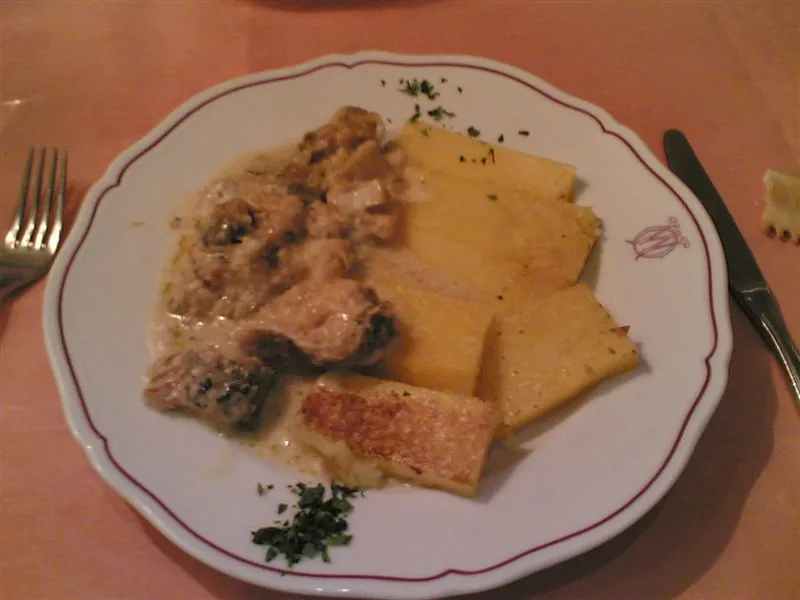
Baccalà alla Vicentina stockfish slow-cooked with milk, oil and anchovies
Stockfish, milk, oil and anchovies, cooked for hours over the lowest heat: baccalà alla vicentina arrived from Norway with a shipwreck in 1432.
Read more →Velo d'Astico is a comune that lost pieces for three centuries. Through the Middle Ages and beyond the territory lay under the counts of Velo, whom Pagliarino called a family «most ancient for the nobility of its blood»; the castle of Velo was given in 1084 to the church of Vicenza by the emperor Henry IV, and there were others, on the Pion hill near San Giorgio and at Meda, on the top of a rise to keep an eye on the valley. In the fifteenth century the vast comune that coincided with the fief began to come apart: Posina was the first to leave, in 1462, then Fusine, Laghi and Cavallara gained their autonomy in 1587. And yet in the second half of the eighteenth century the counts still held the fief of much of the Astico valley, the Forni and the village of Tonezza. The addition «d'Astico» came only in 1867, so as not to be confused with Velo Veronese; what the name means is unknown: perhaps the Roman Velleius or Vellii, perhaps villus, the fleece of a sheep, that is grassy land or a place of shepherds.
Through Velo ran the public road joining Thiene and Schio to the Sette Comuni, to Trento and the towns beyond the mountains: much travelled, and for that reason a barrier was set here for the health checks. It was needed: in the four Venetian centuries the plague came back more than forty times, and the worst were that of June 1575, which started from Caltrano and then spread through the whole Veneto, and that of 1630. In 1797, Venice fallen, the people of Velo planted the tree of liberty with great rejoicing, but the French occupation soon made them regret it, and in 1809 the peasants of Velo, with many others of the Alto Vicentino, rose at Thiene against Napoleonic misrule. In the First World War the village was occupied during the Strafexpedition and many houses were destroyed: the ponte degli Schiri marks the point of the furthest Austrian advance. In 1922 the primary schools and the town hall were rebuilt where the alpini barracks had stood before the war.
Stockfish, milk, oil and anchovies, cooked for hours over the lowest heat: baccalà alla vicentina arrived from Norway with a shipwreck in 1432.
Read more →Straight-line distances from the town centre. Tap a point to open its page.
The closest destinations covered by our editors, with straight-line distance.
Outside Velo d'Astico, but an easy day trip away.


