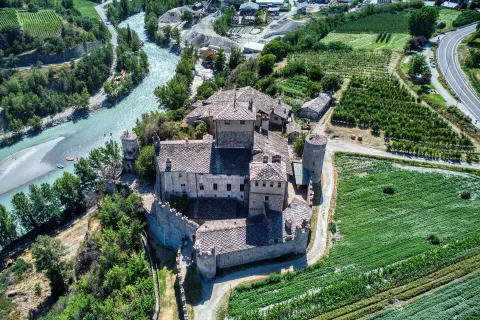
The fairytale silhouette that fills the postcards is barely more than a century old: the four round turrets at the corners of the keep were added by the architect Camillo Boggio after 1873, when baron Emanuele Bollati bought the ruinous castle and decided to turn it into a summer house. Underneath sits one of the oldest castles in the Aosta Valley, first named in a document of 1191.
What to see
The castle perches on a spur of marble rock above the SS26 and the village. From outside it looks like a single block, but it is made of buildings from different centuries: the two older towers go back to the De Sancto Petro, the family that gave it its name, while the square central keep is the one Boggio crowned with turrets joined by a walkway on small arches. At the foot of the spur stand the parish church, rebuilt in 1872 on the foundations of earlier churches, and the twelfth-century Romanesque bell tower with its two- and three-light openings.
Visiting
Since 1985 the castle has housed the Efisio Noussan regional museum of natural science, and it belongs to the comune. It stayed shut for a long time, from 2008 to 2022, for structural consolidation and a complete rethink of the displays; the new layout opened on 25 November 2022. Before the Bollati, the castle had passed from the lords of Quart to the Savoy and the Challant, and in 1600 to the Roncas, whose Pierre-Philibert made it a lavish residence.
Our editors' tip
In 1980 the Italian post office gave it a 900-lire stamp in the Castles of Italy series, which is the quickest way to grasp how much this outline counts in the Italian imagination. Look down the valley too: from up here you can see the Sarriod de la Tour castle on the far side of the village.