In the hall on the first floor of the north wing, the wooden ceiling rests on 171 corbels carved in the fifteenth century: noblewomen in the latest headgear, carnival figures, dogs, ducks, wolves and boars, then a mermaid, a unicorn, a dragon and a whole procession of diabolical monsters. They call it the Hall of Heads, and it is the best reason to cross the orchards to this castle.
What to see
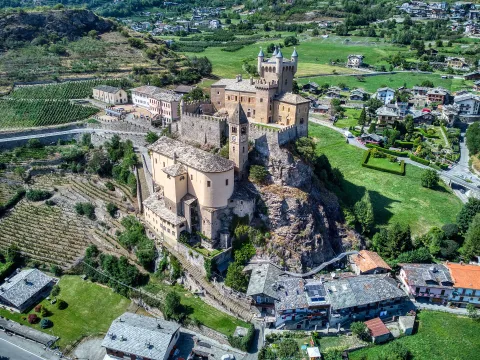
The place is an irregular heap of buildings pushed against one another, grown around the old square donjon, the turris Sariodorum, older than the fourteenth century. You enter through the pointed portal on the east side, with the Sarriod arms carved above it and a crenellated machicolation on a double row of corbels: it was opened around 1470 by Antoine de Sarriod de La Tour, who also gave the walls their round turrets. In the chapel to the south survive fragments of a cycle painted around 1250, one of the rare records of early Gothic painting in the valley; the baroque vault added in 1700 cuts it in half. At the chapel entrance a Crucifixion and a Saint Christopher were frescoed after 1478.
Visiting
The castle stands in the orchard plain along the Dora Baltea, on the side of the village opposite the more famous castle of Saint-Pierre, though its south-eastern flanks still rest on a spur above the river. In 1420 the brothers Yblet and Jean de Sarriod split the family holdings in two: Jean took this tower and enlarged it into a residence fit for receiving. The Sarriod stayed until 1923; since 1970 the castle has belonged to the Region, which opened it to visitors in 2003.
Our editors' tip
Look at it first from above, from the castle of Saint-Pierre: only from up there does the muddle of wings make sense. Then go down and take your time in the Hall of Heads, because 171 corbels do not yield to a single glance.