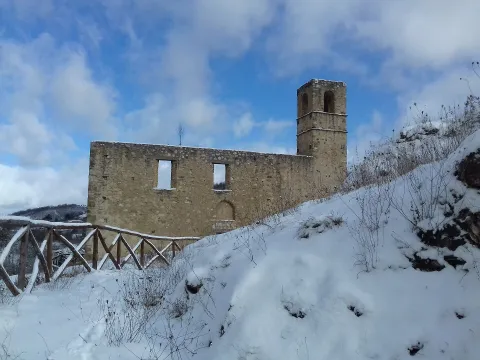
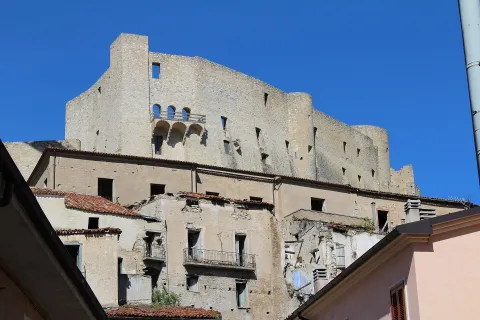
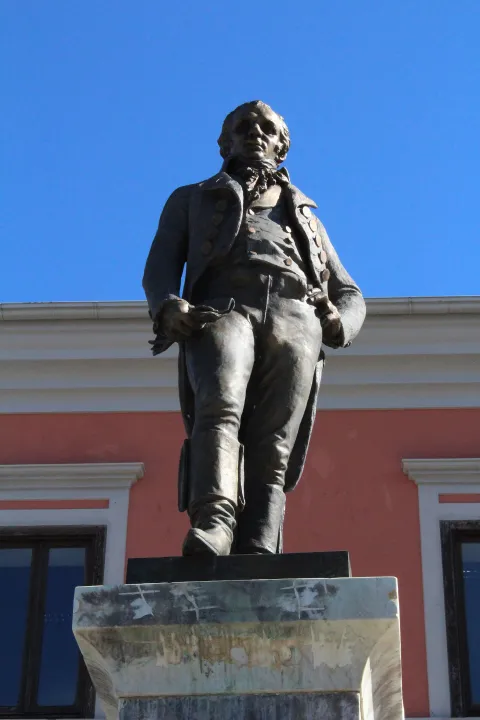
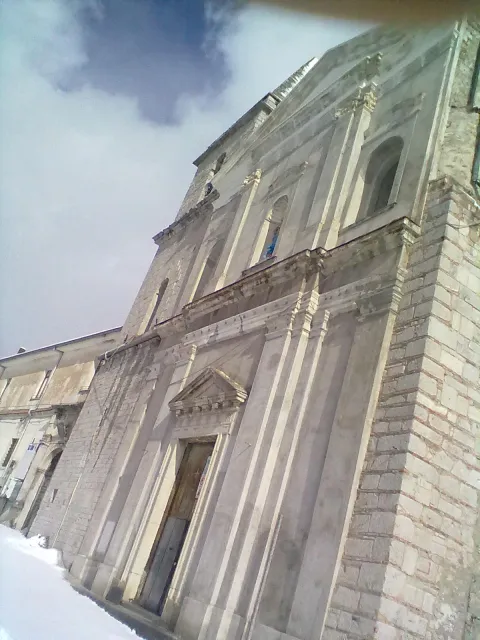
The crucifix does not stay in one place all year: on the first Sunday of May it is carried up on shoulders to the 1100 metres of Monte Sacrato, and it stays there until the third Sunday of September. The chapel on that summit was built in 1238, after a miracle nearby, by the same townspeople who in that year saw Brienza handed over by Frederick II to a new lord, Gentile da Preturo. Devotion grew so strong that around 1375 the "subpatronato del Crocifisso" was founded, a lay association meant to support and spread the cult, and in 1814 the last bishop of Marsico and Grumento declared the mountain consecrated ground.
What to see
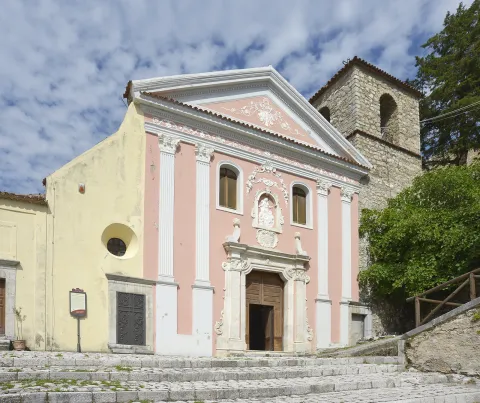
The church has a single nave on a rectangular plan laid out as a Latin cross. Once inside, look up first: the wooden ceiling, grey-green, carries gilded diamond-shaped mouldings and a white dove at its centre. Two altars stand along the side walls, each under a painting: Our Lady of Sorrows on the right, dated 1879, and Christ praying in the garden of Gethsemane on the left, from 1874. A triumphal arch worked in gesso frames the apse, whose vault is frescoed end to end with the Ascension.
The finest work, though, is over the high altar: a fresco of 1733 showing the Pietà, painted with enough attention to detail to mark the lash wounds on Christ's body and give each figure its own face. At the centre is the resigned face of the Virgin. A second fresco, the lament over the dead Christ, was finished in 1773 by an unknown hand.
Visiting
The sanctuary lies inside the Appennino Lucano Val d'Agri Lagonegrese national park, on the summit that looks down over the Melandro valley. The pilgrims' route starts at the church of the Santissima Annunziata and climbs about five kilometres, steep, marked by the small columns of the Way of the Cross. The first documented work on the building dates from 1659, recorded by an inscription on the lintel of the door: most probably a thanksgiving for having escaped the plague of 1656 or the earthquake of 1646.
Our editors' tip
Come on the third Sunday of September, for the descent. After the solemn Mass the figure of Christ is laid on a purple cloth in the rite known as the "vestizione" and carried back down towards the town; at the edge of Brienza it meets the procession of Our Lady of Sorrows, and that encounter is the "affrontata". In the square comes the flight of the angel: a child hung from a pulley on a cable strung between two facing buildings is lowered seven times, showing one of the seven symbols of the Passion each time.