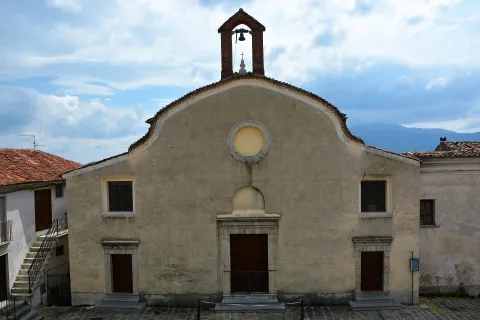
Under the arcades in front of the church, between 1616 and 1634, Girolamo Todisco painted a Crucifixion of the Franciscan Martyrs of Japan: a rare subject in sacred painting, and one that reached this corner of the south only a few decades after the events it depicts. The convent of Sant'Antonio was built from 1512 onwards in the lower part of the settlement, detached from the centre of Rivello, and it remains the finest monument in the comune. Today it is a former convent: on the upper floor, where the cells once were, the archaeological museum is now installed.
What to see
The church was reworked in Baroque forms in the 18th century, yet it keeps much older pieces: canvases from the 16th century, among them an Annunciation signed by Felice Vitale and dated 1597, and a wooden choir from the 17th century. The layering is easy to read here, because the 18th-century remodelling did not sweep away the earlier furnishings.
The cloister was frescoed by Todisco as well, and in the refectory there is a Last Supper by Giovanni Todisco. On the upper floor the archaeological museum gathers finds from the whole basin of the river Noce, the ancient Talao, and from that of the Lao: the two valleys that link this stretch of Basilicata to the sea and to the Cilento.
Visiting
The convent lies in the lower part of the settlement, well away from the historic centre: it is not a stop you tack onto a stroll through the alleys, it needs to be planned separately. The first things to look at are outdoors and require no ticket at all, since Girolamo Todisco's frescoes are under the arcades in front of the church. After that comes the interior, then the cloister and the refectory, and finally the climb to the upper floor for the museum.
Our editors' tip
Give yourself time to compare the two Todiscos who worked in this building: Girolamo under the arcades and in the cloister, Giovanni in the refectory with the Last Supper. And under the arcades, look for the Crucifixion of the Franciscan Martyrs of Japan: that is the scene you will take away with you, because very few painted versions of the subject survive, and finding one in a convent in southern Basilicata is the best reason to make the detour down here.