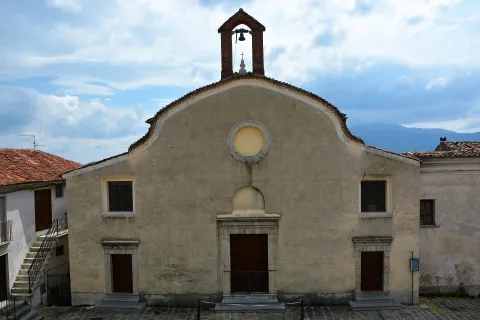
In August 1806 Napoleon's soldiers, passing through while they laid siege to nearby Lauria, sacked the parish church of San Nicola di Bari and the crypt beneath it: in the crypt they went so far as to stable their horses. The building is medieval in origin and was enlarged and raised in the first half of the 18th century, partly on the ruins of Rivello's old castle. It stands in the upper quarter of the town, the one belonging to the bardàv'ti, tied to the Latin-rite church, while the lower quarter answered to the Greek-rite parish of Santa Maria del Poggio: two communities, two rites, two churches at opposite ends of the built-up area.
What to see
The facade is fronted by an 18th-century stairway worked entirely in local stone, and it is the part of the building that owes most to the 18th-century enlargement. Inside there are canvases from the 18th century, among them a Madonna of the Rosary by Paolo de Matteis datable to around 1715-18, and frescoes from the 19th century.
Below the church, however, lies what makes San Nicola unlike any other parish church in the area: the crypt, with cross vaults carried on slim columns of local stone. In size it is second only to the crypt under the basilica of San Nicola in Bari, the church this one is named for.
Visiting
You reach it at the highest point of the town, where the church rests in part on the castle ruins, and the first thing to look at is the stairway seen from below, before you climb it. Since this is the parish church, opening times follow the services: if you find it closed, come back around Mass time and ask then to go down into the crypt, which remains the oldest and most surprising space of the whole complex.
Our editors' tip
Once you are back up from the crypt, walk down towards the lower quarter as far as Santa Maria del Poggio. The two churches are not far apart by accident: for centuries they served two communities that eyed each other from one end of Rivello to the other, the bardàv'ti up here and the bardàsci down there. Make the walk on foot and the story of the two rites, which in books reads like a scholarly footnote, simply becomes the shape of the town.