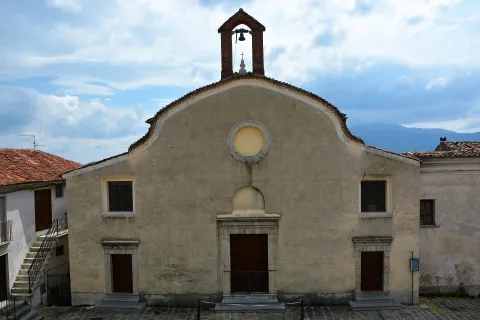
The apse of the church of Santa Maria del Poggio ends in a sheer drop over a crag. The building takes up the entire top of the hill that Rivello calls the Poggio, and from a distance its outline is that of a fortress rather than a parish church. The original building, though, is not this one: it sits on the floors below and is the chapel of San Giovanni, which goes back to the early Middle Ages. During the 18th century the church was enlarged and raised, and the old chapel ended up absorbed into the lower level instead of being pulled down. For centuries Santa Maria del Poggio was Rivello's Greek-rite parish, the one serving the lower quarter, whose people were called bardàsci, while at the other end of the town San Nicola di Bari kept the Latin rite.
What to see
The interior was reworked in Baroque forms after the 18th-century raising, but it keeps two pieces older than its present dress: a 16th-century baptismal font and a 17th-century polyptych. These are the objects that came through every transformation of the building, from the early medieval chapel to the fortress-church you see today.
The other thing to look at is the structure itself, which reads better from outside than from within: the church grows over several levels because it was built on top of the older one rather than in its place, and the apse end runs right to the edge of the rock with no margin at all.
Visiting
One thing to know first: the church is closed for restoration because of damage from the earthquake of 9 September 1998, which hit historic buildings hard in this part of Basilicata, and reopening depends on how the works proceed. For now the visit is an exterior one, and that is not a small thing: walk up from the lower quarter and go round the building to the apse side, the point where the relationship between the masonry and the crag becomes obvious.
Our editors' tip
Before climbing to the Poggio, stop at two names you will find in the local street map, Piazza dei Greci and Fonte dei Lombardi: they tell the same story as this church. The Greeks are said to have arrived from nearby Velia after its destruction by the Saracens, the Lombards had settled after the barbarian invasions, and the two communities split Rivello into two quarters with two parishes and two rites. From up here, with San Nicola di Bari at the opposite end of town, you can see that division with your own eyes.