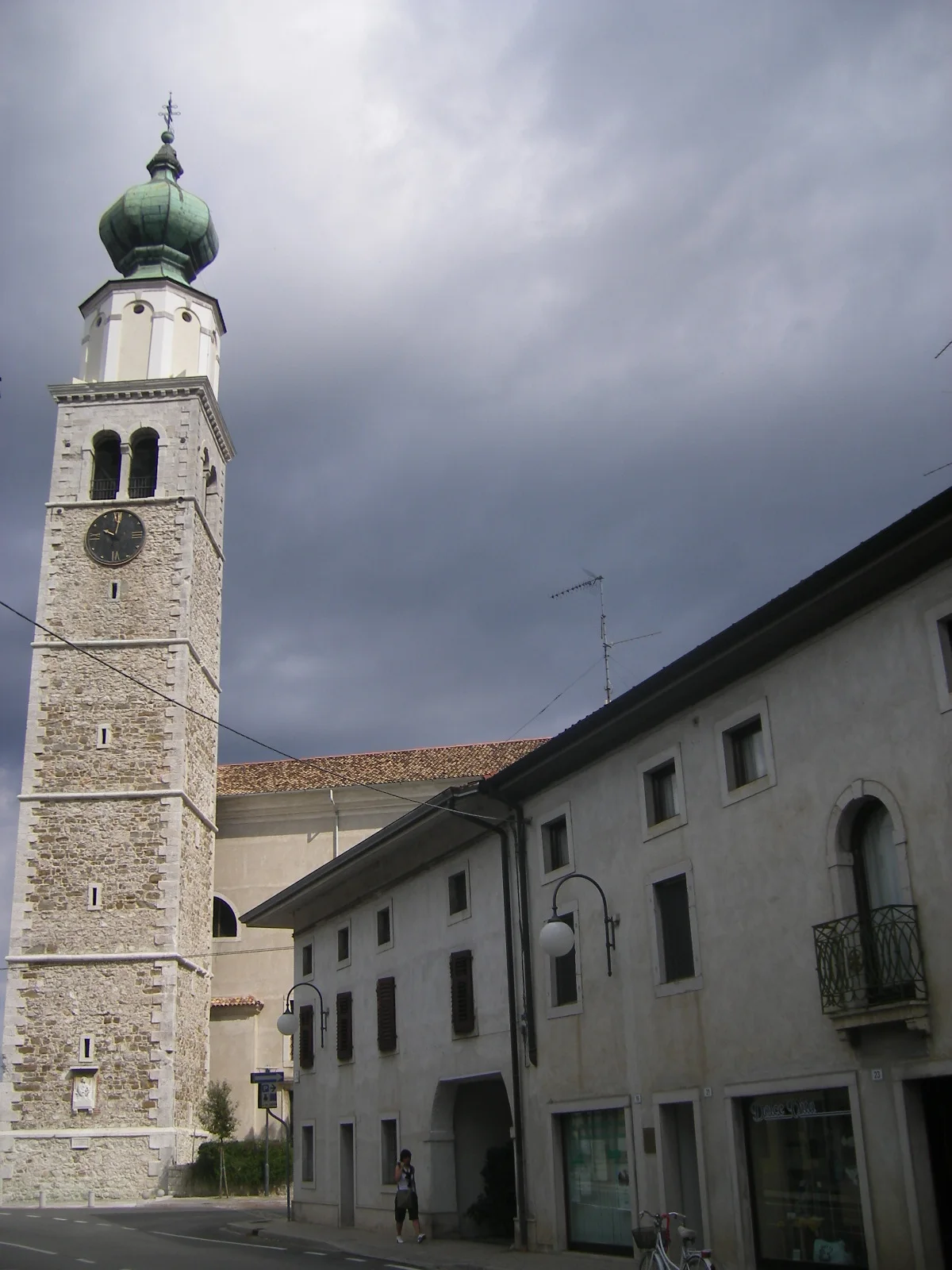
In 1882 the Trieste irredentist Guglielmo Oberdan crossed the border clandestinely to make an attempt on the life of emperor Franz Joseph, then visiting Trieste. At Versa he was noticed by the town messenger, who spoke of it to the mayor Giovanni Natale Baldassi, who reported the suspicion to the gendarmerie at Gradisca; Oberdan took refreshment at a local inn — still open — set off again towards Trieste and was arrested at Ronchi largely thanks to that report. The emperor conferred on the mayor a gold cross of merit with crown, «in recognition of their particular assiduity to public security». It is the most direct way to understand which side of the border this village was on: until 1919 Romans was Austrian, and it fought the Great War as such. Conscription into the Austro-Hungarian army was compulsory from eighteen to forty; the men ended up on the eastern front in Galicia, and those taken prisoner spent the years in camps in Ukraine, where they saw the Russian revolution close up. Between Romans, Versa and Fratta the war cost seventy-two dead in Habsburg uniform, and on their return the survivors were treated as suspects under special watch: no military honours, because they had fought on the wrong side.
On 25 May 1915 the Italian troops arrived and the village became a rear area, with its field hospitals; along its streets passed Vittorio Emanuele III, Enrico Toti, a young bersagliere named Mussolini and Giuseppe Ungaretti, who wrote some of his best-known lines at Versa itself. Beneath all this there is much more: in 1986, at San Zorç, one of the largest Lombard necropolises in Italy was discovered. A document of 2 February 1170 names the three settlements of the territory — Latina, Raccogliano and Pradigoi — and two of those names are of Slavic origin, because around the year one thousand the patriarch of Aquileia had repopulated with Slovene people a land emptied by the Hungarian raids. In 1326 a centa is mentioned, that is the houses gathered and fortified around the church: it was there that people took refuge during the Turkish raids of 1472, of 1477 and in the terrible one of 1499.
Straight-line distances from the town centre. Tap a point to open its page.
Near Romans d'Isonzo
The closest destinations covered by our editors, with straight-line distance.


