The courtyard alternates stucco atlantes with female masks: a language nobody had yet used in mid-sixteenth-century Genoa, apart from the contemporary palazzo Grimaldi at San Francesco di Castelletto. Admiral Antonio Doria, marquis of Santo Stefano d'Aveto and a relative of Andrea Doria, had it built between 1541 and 1543, standing alone among greenery near the Acquasola gate. Doria worked as a strategist for the Spanish Crown and wrote a treatise on war at sea; the design of the building is close to Bernardino Cantone, perhaps working with Giovan Battista Castello.
What to see
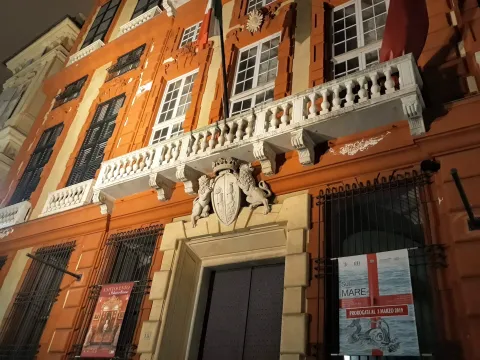
The façade still carries the frescoes of Lazzaro and Pantaleo Calvi, brought back in a restoration of 2001, and the marble portal with paired columns and figures of men-at-arms on the attic, added by Taddeo Carlone at the end of the sixteenth century. Inside, the entrance hall displays the Deeds of Antonio Doria attributed to Marcantonio Calvi, legible again after the removal of the nineteenth-century repainting by Filippo Alessio and Michele Canzio. The square courtyard with its two tiers of loggias is the heart of the house.
In the upper loggia, Aurelio and Felice Calvi painted city views copied largely from the Civitates orbis terrarum, the atlas printed in Cologne in 1576: a choice that says a great deal about the owner's interests. The main rooms move from Apollo shooting the Greeks before Troy to Hercules fighting the Amazons; they were executed by the workshop of Giovanni Cambiaso, and here his son Luca, perhaps seventeen years old, signs his first demanding work. Rubens engraved the palace in his collection of the Palaces of Genoa in 1624, and those plates are the only record of the original layout.
Visiting
The palace is at largo Eros Lanfranco 1, two minutes from piazza Corvetto, and houses the Prefecture and the Metropolitan City of Genoa: the state rooms can be visited, but the hours follow the work of the offices, so check before going. The best chances are the Rolli Days, when the palaces on the old lists open together. This is one of the 42 buildings added in 2006 to the UNESCO World Heritage list as Genoa: Le Strade Nuove and the system of the Palazzi dei Rolli.
Our editors' tip
Before going in, look at the right-hand corner of the building, towards via Roma: it is cut clean off. In 1877 the opening of the street took away the gallery frescoed by Andrea Ansaldo, the garden and a slice of the façade, and lowered the street level further. Knowing that, the courtyard and the loggias look different: they are what survives of an urban villa that once stood in open green.