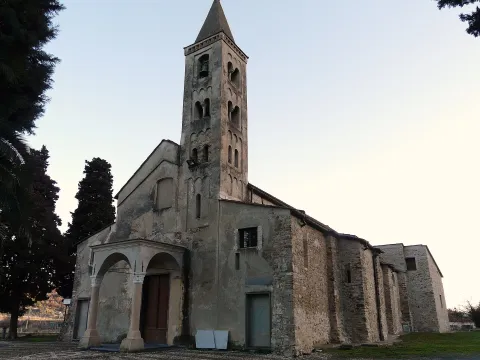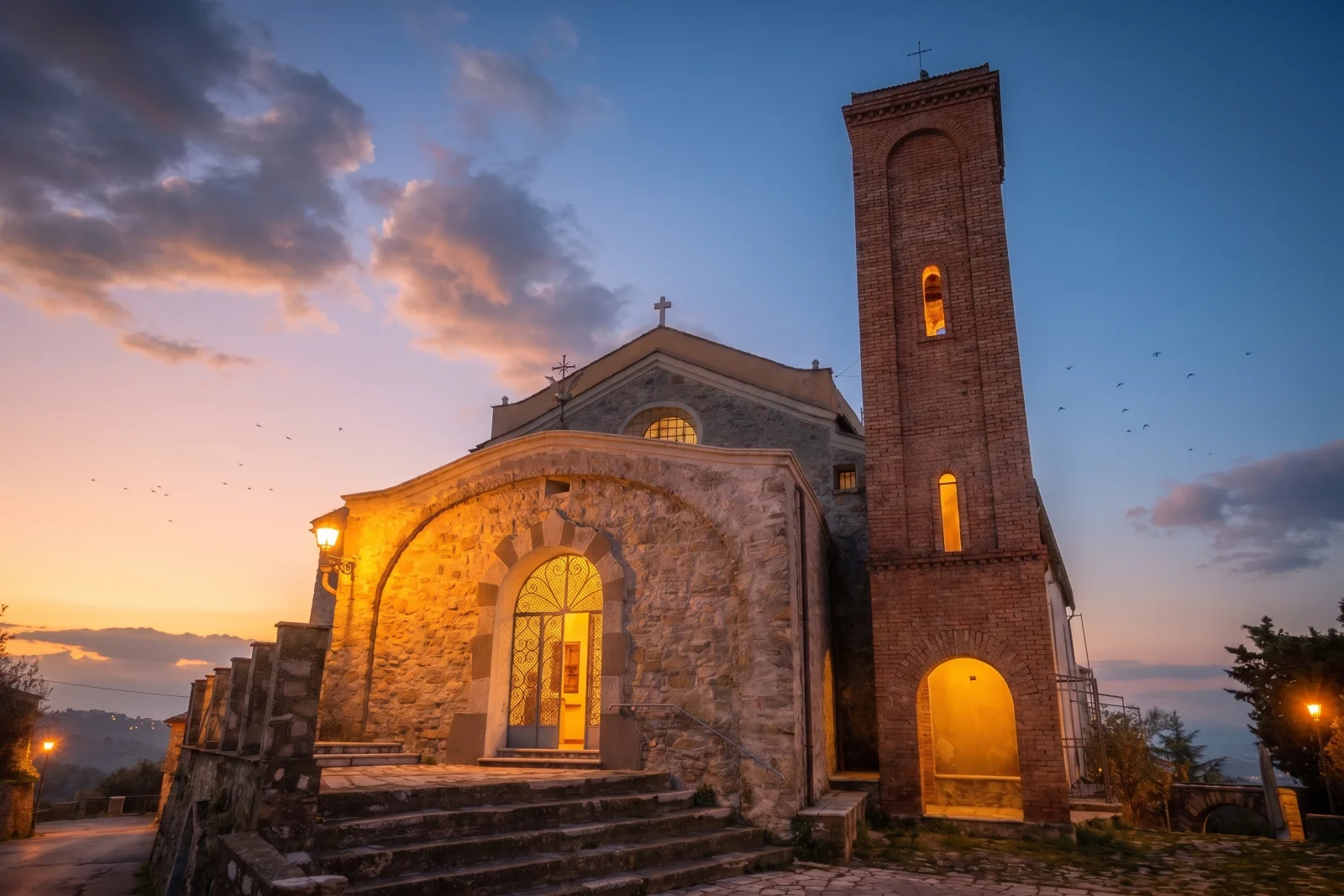
Photographs taken in 1915 still show the remains of a Roman castrum around the sanctuary; the restoration carried out between 1950 and 1960 removed them. Before the church there was a watchtower on the summit of Monte Tirasso, raised in the early Middle Ages by the commune of Albenga to keep an eye on the valleys below; beside it, tradition says, sailors and townspeople of Alassio led by the Benedictines built a chapel dedicated to Stella Maris in 1100, or more probably in 1200. Pilgrims climbing from the coast and from the Merula, Arroscia and Lerrone valleys made the case for enlarging the little shrine in the seventeenth century, partly reusing the stones of the old tower; further work followed between 1855 and 1898.
What to see
The layout is the seventeenth-century one: three naves separated by side piers. On the walls hang the ex voto left by the faithful in thanks for favours received, and most of them tell stories of the sea, which was the family trade of half the town. In the chapel off the left nave stands a wooden group of the Madonna della Guardia, recalling the apparition of 1490 on Monte Figogna, between Genoa and Ceranesi.
During the eighteenth-century enlargement two massari and notaries of Alassio, Marcellino Brea and Giovanni Battista Rossano, gave the statues of the Virgin and the angels and an image of Christ ascending to heaven. The vault of the central nave was frescoed by the Genoese painter Virginio Grana between 1859 and 1860; the right-hand nave holds the organ built by Beniamino Giribaldi. The sanctuary belongs to the diocese of Albenga-Imperia.
Visiting
The church stands at 586 metres above sea level, on the highest point of the Tirasso ridge, and from there it commands Alassio and the whole gulf: the climb is the price of the view, and it is also why the sailors chose this spot. It is a working sanctuary, so times follow the services; ask at the parish before setting out.
Our editors' tip
Our advice is to give the ex voto more time than the view. Read one after another, the painted tablets and photographs add up to a register of shipwrecks survived by a town that lived off the sea for centuries; Monsignor Innocente De Ferrari, rector during the years of the restoration, called the place the spiritual lung of the local church.