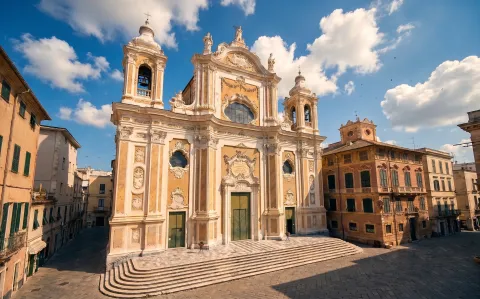
The cloth falling from the high altar table looks like embroidered fabric, folds and fringe included: it is marble, carved by Pasquale Bocciardo in 1799. The collegiate basilica of San Biagio stands on the square of the same name, inside the walls of Finalborgo, the old core of Finale Ligure. Saint Blaise protects wool carders, and wool was serious business here: the Genoese customs regulation of 1128 lists the people of Finale as exporters of wool and hemp. The church itself, however, appears in a written document only in 1261, with a shelter for the sick attached to it of which nothing survives. In April 1949 Pius XII raised it to the rank of minor basilica.
What to see
The present building went up between 1633 and 1650 to a design by the local architect Andrea Storace: Latin cross plan, three naves, central dome. It replaced a Gothic church raised inside the walls between 1372 and 1375, pulled down almost entirely because it had become too small, its axis turned ninety degrees from the new one; the fourteenth-century apse and apsidal chapels survive in the narrow gap between the seventeenth-century fabric and the town walls. The octagonal bell tower, with its slender two-light windows, rests on a defensive tower older than 1452. The façade was left rough and never finished.
Much of the furnishing was not made for this church: it came from the convent of Santa Caterina, confiscated first by Napoleon and then by the Italian state in 1864. The first altar on the right holds a triptych of the mystic marriage of Saint Catherine of Alexandria: when it was moved to San Biagio, Saint Gotthard was turned into Saint Blaise by putting a wool carder's comb in his hand. The second altar carries the large altarpiece by Pascale Oddone, dated 1533. Then come the marble pulpit by Pasquale Bocciardo, with Ezekiel's vision and the tetramorphs, and the frescoes of the dome and the presbytery vault, painted in 1878 by Francesco Semino and Domenico Buscaglia.
Visiting
Finalborgo is walked, not driven: cars stay outside the gates and the square is a few minutes from Porta Testa. The basilica is the parish church of the borgo, in the diocese of Savona-Noli, and opens for services; in the early afternoon it may be shut. Inside the light is low, so give your eyes a minute before hunting for details in the side chapels.
Our editors' tip
We always go out at the back, into the narrow corridor between the church and the town walls: from there you can touch the masonry of the Gothic apse, the only piece left of the fourteenth-century church. Then go back in front of the high altar and look at the marble cloth sideways, against the light coming down from the dome.