Seven metres below the surface, laid on a bed of red ochre and facing south, lay a boy of about fifteen: a cap of shells, bone ornaments, worked deer antlers and a long flint blade still in his hand. Archaeologists call him the Prince of the Arene Candide. He lived in the Gravettian, about 26,000 years ago, and the wound that killed him, to the face, had been packed with yellow ochre before burial. He came out of this cave above Finale Ligure, and his is one of the best preserved Palaeolithic burials in the world.
What to see
The cave opens about 90 metres above the sea, on the western edge of the former Ghigliazza quarry, inside the Caprazoppa headland. Three wide mouths facing the water keep it dry and lit, and that is why bone, shell and charcoal survived here through a sequence running from the Upper Palaeolithic to the Byzantine period. The name comes from the dune of white sand — arena candida — that lay at the foot of the cliff until the early 1920s; locally the cave was also called Grotta dei Frati, or Armassa.
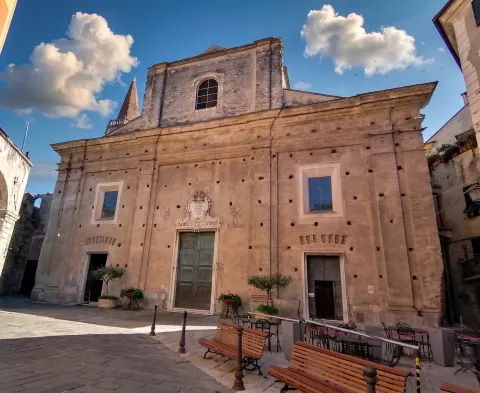
The first to study it was Arturo Issel, who climbed up in June 1864. The decisive digs, though, are those of Luigi Bernabò Brea, the first superintendent of antiquities for Liguria, and Luigi Cardini, carried out between 1940 and 1942 and again between 1948 and 1950 in the south-eastern part of the cave: they produced 19 Palaeolithic burials, one of the largest funerary groups known. The finds did not stay underground: they are shown at the Museo Archeologico del Finale in Finalborgo, at the Museum of Ligurian Archaeology in Genoa Pegli and at the Pigorini Museum in Rome.
Visiting
The site belongs to the state; since 2018 it has been entrusted to the town of Finale Ligure and the Museo Archeologico del Finale, which reopened it regularly to visitors in July 2019 after securing the path. You come in from above: the trail starts at Borgio and takes about half an hour, downhill on the way there and uphill on the way back. The guided visit has to be booked, walking boots are needed, and the path is no place for a pushchair.
Our editors' tip
Do the cave and the museum on the same day, in that order: first the cavern, which today is mostly a large bright void facing the sea, and only afterwards the cases at Finalborgo. That way you may recognise, behind the glass, the blade and the shells you have just pictured in place, under seven metres of earth.