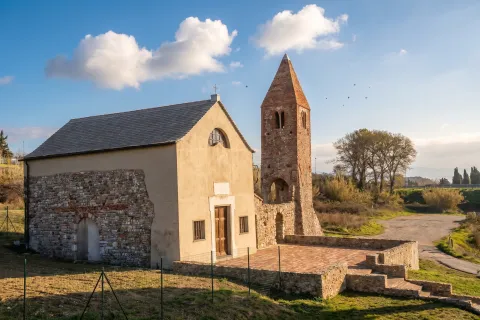
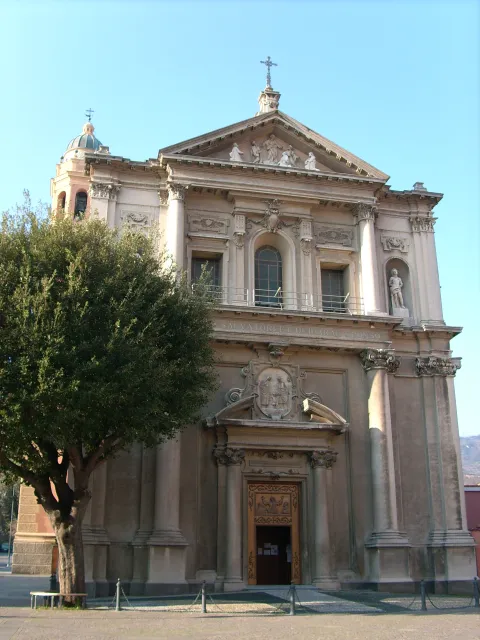
Under the pedalboard of the organ at Sant'Anna, four pedals play no notes at all: they operate the Timpano, the Uccelliera, the Campanette and the Ottavino, the sound effects that nineteenth-century Tuscan organ builders liked to install in village churches. The instrument is opus number 540 by Nicomede Agati e Fratelli of Pistoia and carries the date 1870. The church around it grew by successive additions from a chapel blessed on 26 January 1625 and dedicated to Saint Anne and Saint Anthony.
What to see
The seventeenth-century chapel survives as a floor plan: a single nave, which is now the left aisle, with the bell tower set into the facade. Everything else is nineteenth-century work. Between 1826 and 1860 the building was widened into the three naves it has today, which were then extended; the round-arched vault was decorated in 1897 by Federico Dagnino, and the facade came last, in 1905.
The apse is semicircular, with a marble high altar and wooden choir stalls, and two smaller square-plan presbyteries open at the head of the side aisles. Among the sculptures, look for the wooden processional crucifix, restored in 2011 and cautiously attributed to Stefano Murialdo. The organ, originally in the gallery above the main door, now stands in the apse directly on the floor: a plain painted wooden case, a keyboard of 50 boxwood keys with a short first octave, a lectern pedalboard of 10 pedals, and stops pulled by knobbed rods with their names written by hand.
Visiting
Cadibona is a hamlet of Quiliano, and the church stands along state road 29 over the Colle di Cadibona, the pass that school geography gives as the boundary between the Alps and the Apennines: most people drive past it on the climb inland from Savona. The parish was created on 18 September 1797, split off from San Lorenzo di Quiliano, and today belongs to the Savona vicariate of the diocese of Savona-Noli. Like every roadside parish church, it opens irregularly; Mass times remain the most reliable guide.
Our editors' tip
Our advice is to look at the organ closely, now that it sits on the floor of the apse rather than high above the door: the 23 pipes of its front are arranged in a winged cusp and their mouths run counter to the cusps, a detail you only catch standing underneath. Then look at the two wedge bellows with six folds and their original weights still in place: the air comes from an electric blower now, but the ropes and pulleys that once worked them by hand were never taken away.