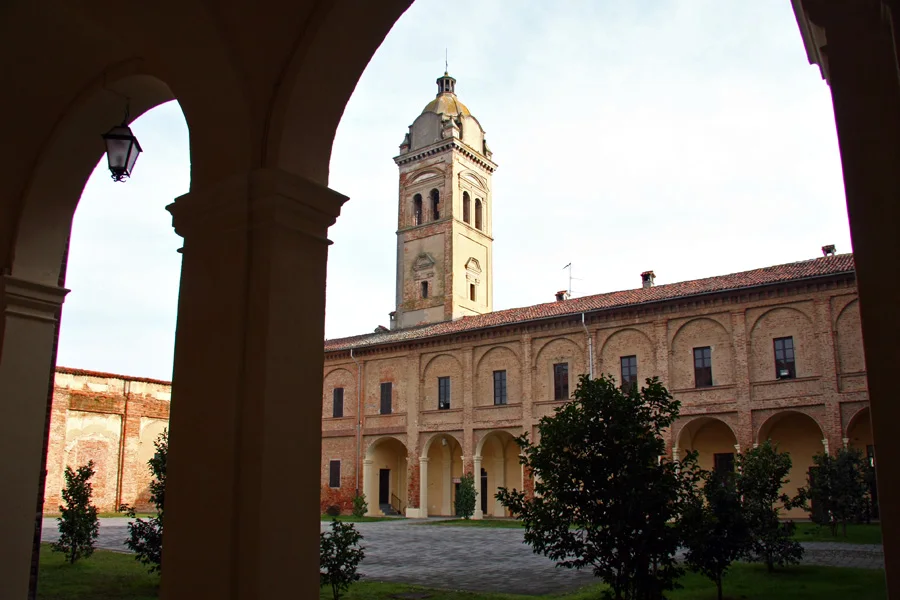
Breme has 853 inhabitants in the lower Lomellina, at the confluence of the Sesia and the Po. The village grew around an abbey with a displaced-persons history: in 929 the monks of the Novalesa, in the Alps, arrived here after the Saracens had destroyed their house, and refounded it as San Pietro di Breme. Of that tenth-century building only the crypt survives, with the columns that divide three small naves; the monks' refectory, the kitchen and the ice house can still be visited.
Breme also sat exactly on the border between the duchy of Milan and Monferrato, and that made it a fortress on a pentagonal plan: in 1638 the French took it and the Spanish took it back after a long and bloody siege. The stronghold is gone, but it has stayed in the coat of arms: a scholar who in 1904 studied the civic seals of the province read the castle on the shield as precisely that destroyed fortress, and the wood behind it as the origin of the word the village takes its name from. Today Breme is known for something smaller and sweeter, its red onion, which has had its own festival since 1983 and is a Slow Food presidium. Just as well, because in a century the village has lost two thirds of its people.
Straight-line distances from the town centre. Tap a point to open its page.
Near Breme
The closest destinations covered by our editors, with straight-line distance.


Places to see within 25 km
Outside Breme, but an easy day trip away.