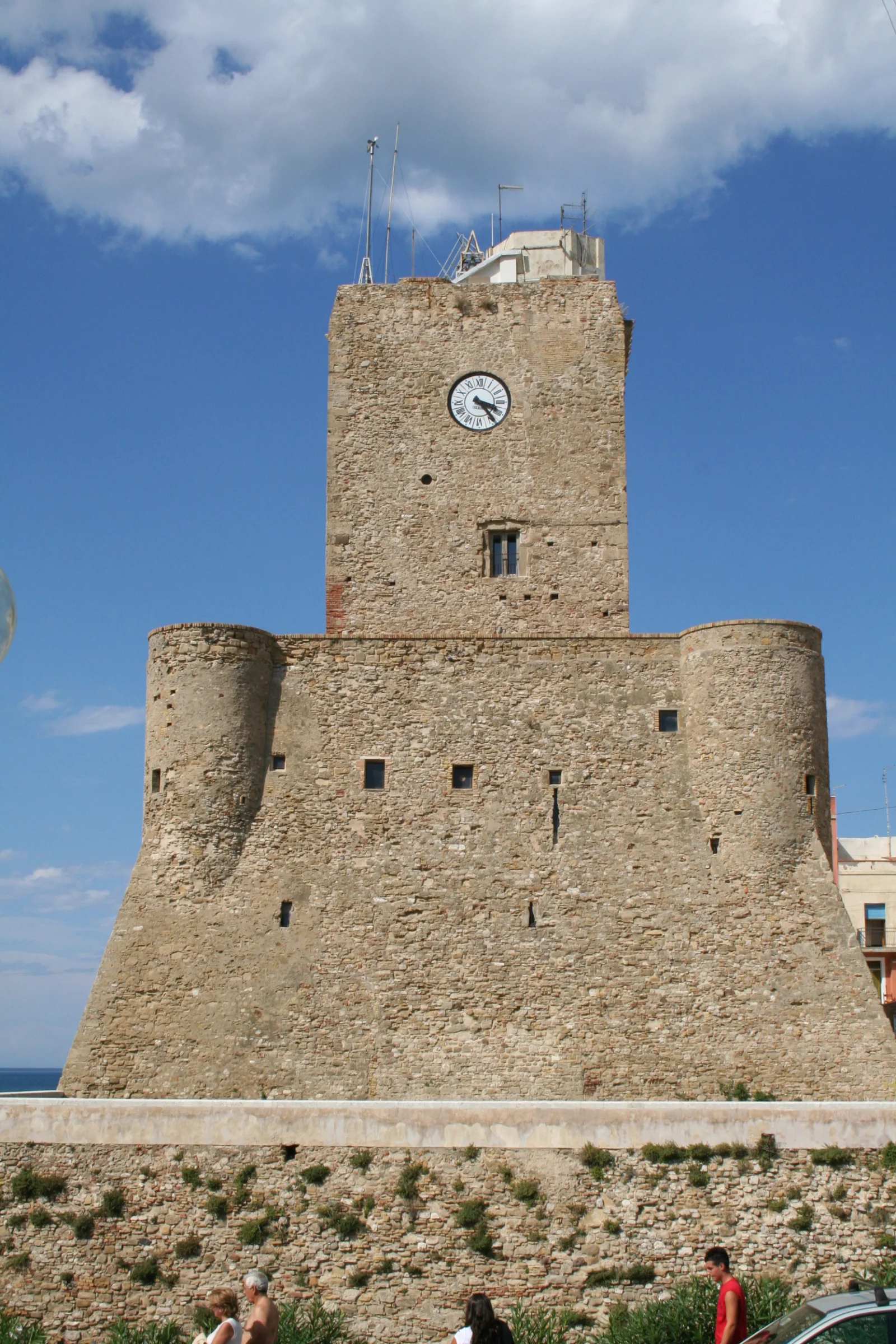
A crack six metres long runs across the left face of the castle: the earthquake of 1627 opened it, masons later filled it in, and it can still be read. That shock, which struck the Gargano area hardest, caused only light collapses in Termoli but lifted the rocky shoreline, and the resulting misalignment is still visible in the middle of the western front. It is the clearest mark of a history made of earthquakes, raids and patch-ups, which the castle carries in plain sight.
The core is older than the name. At the centre stands a square Norman tower, built entirely in brick and roofed with a barrel vault; around it, the truncated-pyramid structure with four projecting corner towers is the work ordered by Frederick II of Swabia, dated 1247 by a plaque found inside one of those towers. Earlier still, in 1239, the emperor was granting the people of Termoli the right to hold a weekly market within the walls of the old castrum.
What to see
The lower floor served as warehouse and store: four large rectangular rooms with barrel vaults arranged around the Norman block. The first floor is the so-called Corridoio degli arcieri, the archers' corridor, where the slits allowed archers and crossbowmen to shoot downwards; from here the corner towers open out, along with the only original entrance, on the north-east side, where the corbels that ran the ropes and winches of the drawbridge towards Montecastello are still in place.
Up on the terrace the stone corbels still jut out: they once carried the wooden platforms used for dropping fire on attackers, and only later became a decorative support for battlements. In the lower cistern, during its spell as a Bourbon prison, someone left charcoal drawings that came back to light during the restoration works.
Our editors' tip
Look at the castle from the sea side, where it rises highest: this was a lookout post over the Adriatic, and its geometry only makes sense from there. On 2 August 1566 the fleet of Piyali Pasha came in from that same water and put the town to fire and sword. The castle has been a national monument since 1885.


