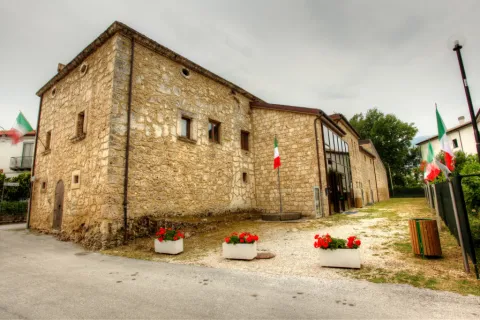
In the state hall, the largest room of the piano nobile, the preparatory layers of the decoration still show a tally of working days, along with sketches, drawings, caricatures and inscriptions. It is the shortest way into what the Museo nazionale di Castello Pandone in Venafro actually is: a building that exhibits itself first of all.
What to see
The upper floor belongs to Enrico Pandone's horses. The count had the stallions he bred painted in every room, using relief plaster worked in fresco, so that the animals stand slightly proud of the wall. Each one carries his monogram, an H inside a circle, a bit painted as though hanging from a nail, and a caption giving the horse's name, breed, age and the person it was destined for: Italian noblemen for the most part, and in one case Emperor Charles V. Read in sequence, those labels map the connections of a family at its peak. Later the Lannoy had the rooms redecorated to erase the memory of the fallen family, which is why the cycle now survives in patches.
The second floor unfolds as a timeline of art in Molise. It opens with seventh-century fresco fragments from the former convent of Santa Maria delle Monache in Isernia and closes in the early twentieth century with the woodcuts, photographs and watercolours of the Musa collection. In between: the alabaster Passion polyptych from the church of the Annunziata in Venafro, carved in the fifteenth century by a Nottingham workshop; the fourteenth-century Madonna and Child from Santa Maria della Strada at Matrice; the wooden Christ from San Giorgio in Campobasso; a drawing by Mattia Preti and the Pan and Syrinx attributed to Luca Giordano. The Giuliani collection, bought by the State in 1990, is shown in rotation: drawings, prints and sketches that change from one visit to the next.
Our editors' tip
Before going up, walk round the base of the keep: the megalithic blocks of the oldest core are still there beneath the Lombard tower, while the moat and the three round towers with tapering bases date from the Angevin period. The castle came to the Pandone in 1443 under the Aragonese, and in the seventeenth century passed to the Lannoy, then the Peretti Savelli and the Di Capua. Reading those layers from outside makes far more sense of what you see inside.