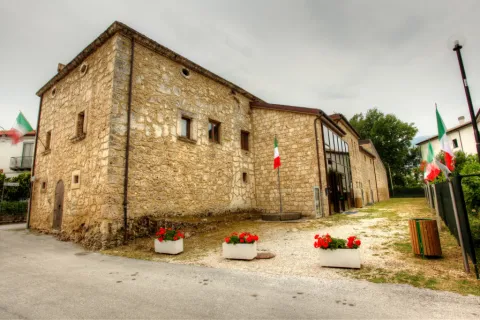
In 1958 a landowner was working his plot in the countryside around Venafro when he struck a «stone» that was far too big: it was a Venus of the Antonine period, a copy of one of the most celebrated models of antiquity, the Venus Landolina. Ever since, everyone has called it the Venus of Venafro, and it stands on the ground floor of the former monastery of Santa Chiara, home of the national archaeological museum. It most likely belonged to a fountain in a wealthy residence of the Augustan age.
What to see
The Samnite section turns on the necropolis found in the countryside of Pozzilli, tied to a settlement in use from the sixth to the second half of the fourth century BC. The grave goods are plain, spears, javelins, brooches and a single sword, yet the quantity of imported pottery tells another story: black bucchero made in Capua, red bucchero produced between northern Campania and southern Lazio, a sign of lively trade. Tomb number 55 has been rebuilt in full, and the vessels heaped inside show how much its occupant counted. Later come black-glaze wares and more uniform sets, at times proper drinking services in the Greek manner.
From the Roman period there are marbles from public buildings and private houses, architectural friezes and statues from the theatre. The imperial cemeteries supplied funerary inscriptions and, above all, a crowd of bare markers bearing only the name of the dead, driven into the ground along the roads outside the town. Look for the stone of Tilla Eutychia, the only priestess of Venafro whose name survives, and the giant face of a Gorgon.
Visiting
The aqueduct room is the core of the museum. It holds the so-called Tavola Acquaria, the large stone carrying the edict of Augustus drawn up between 17 and 11 BC, in the very years when the conduit was being built to bring the water of the Volturno springs into town over a course of more than thirty kilometres. The edict laid down how the work was to be built, how the water was to be shared and which magistrates ruled on disputes. Around it stand the markers that, set beside the conduit, ordered the passage to be kept clear. On the second floor, in a room of its own, is the alabaster altar from the chapel of the church of the Annunziata: one of the few English-made polyptychs left intact in Italy.
Our editors' tip
The museum opened in June 1931 with material that had surfaced by accident on a building site on the slopes of Monte Santa Croce: capitals, cornices and two large male statues of the Julio-Claudian age, read at the time as Augustus and Tiberius, taken to Naples as the custom then was and returned only for the opening. Then the war shut everything down and the convent rooms took in the displaced and school classes. Keep it in mind: almost every piece in here arrived by luck and stayed by stubbornness.