Almost everything we know about the origins of this place comes from a book. Around 1130 a monk named Iohannes compiled the Chronicon Vulturnense, an illuminated manuscript in Beneventan script now kept in the Vatican Library. It tells the story of three noblemen from Benevento — Paldo, Tato and Taso — who in 731 spent their entire family fortune to found a monastery on the banks of the Volturno, where an oratory dedicated to Saint Vincent already stood.
That decision produced one of the most powerful abbeys in Europe. In 787 Charlemagne granted it fiscal and jurisdictional privileges, and in the following century, under the abbots Iosue, Talaricus and Epiphanius, the community came to resemble a small town rather than a convent. Then the collapse. In 860 a heavy tribute was paid to Sawdan, emir of Bari, so that he would spare the place; in 881 Saracens in the pay of the duke of Naples got in anyway, helped by treachery among the servants, and burned it. The surviving monks fled to Capua.
What to see
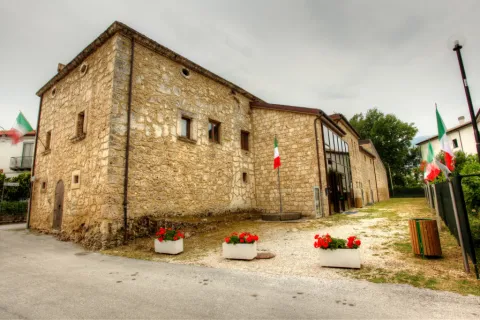
The visit splits across the two banks of the river. On one side stands the later abbey, built on more defensible ground and consecrated by Pope Paschal II in 1115: a Romanesque front with a round-arched portal and a wide oculus, three naves under ribbed cross vaults, a semicircular apse still carrying traces of thirteenth-century frescoes. Next to it the L-shaped abbey palace, faced in dressed stone, houses the monastic community and is closed to visitors except during prayers.
Across the water you cross the Ponte della Zingara, a seventeenth-century single-arch stone bridge, and enter the excavation area. You walk the brick-paved entrance corridor, look into the trapezoidal garden court with its porticoes along the north and east sides, and pick out the remains of the towers and the enclosure wall. These are the levels of the monastic town burned in 881, brought back to light by the San Vincenzo Project, begun in 1980 and now directed by Federico Marazzi.
Our editors' tip
The earthquake of 1349 finished what the Saracens had started, and for centuries no stable community lived here. One returned in 1989, when Benedictine nuns arrived from the abbey of Regina Laudis in Connecticut. It is worth timing your visit around the liturgy: hearing the singing in a church rebuilt after the bombing of the last war, a few hundred metres from the ruins of the early medieval one, is the quickest way to understand what continuity means in a place like this.