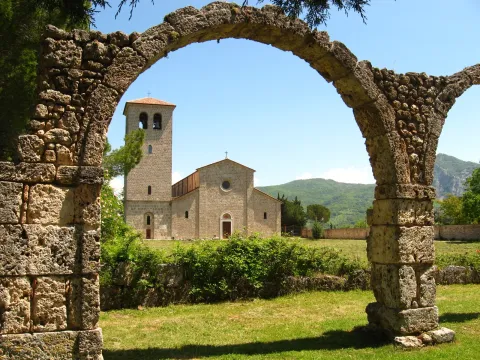
People in Venafro call it «Marzo Settecappotti», March Seven-Coats. It is an oddly shaped bas-relief connected with Bishop Pietro of Ravenna, and on its own it tells you that this church has been built more than once. Dedicated to the Virgin Mary assumed into heaven, it is the largest church in town and one of the largest in the region; locals simply say the Cattedrale, or the Vescovado. Since 1986 it has been a co-cathedral of the diocese of Isernia-Venafro, formed by joining the old Venafro see to that of Isernia.
What to see
The first church went up at the end of the fifth century under Bishop Costantino, on the site of a pagan temple and out of material taken from older buildings: Roman blocks and Early Christian carvings reused with little ceremony. That building fell into ruin and was rebuilt in the second half of the eleventh century by Pietro of Ravenna himself. The new one had a rough life too: stripped by the troops of Frederick II, damaged by the earthquakes of 1349 and 1456, made to billet the soldiers of Charles VIII in 1495. Repairs and alterations never really stopped afterwards.
Inside, three aisles open up, with paintings from the fourteenth century. Of the five portals, the one to the right of the main entrance has been a holy door since at least 1508. Four side chapels line the right-hand aisle; on the left you enter the chapel of the Blessed Sacrament, so large that in Venafro they call it the Cappellone. In the chapel of the Crucifix, finished in the sixteenth century, the altarpiece is attributed to the school of Domenico Antonio Vaccaro.
Visiting
Between the late seventeenth century and the whole of the eighteenth the cathedral was dressed in Baroque forms, an overhaul so thorough that on 21 October 1764 Bishop Francesco Saverio Stabile reconsecrated it. Then taste turned again: restoration work in the later twentieth century removed almost all the Baroque and pushed the building back towards its Gothic medieval look. What you see now is a recent decision, worth knowing as you take in the bare walls.
Our editors' tip
In February 1935 Canon Nicolino Passarelli had a confessional taken away for repair and noticed traces of colour under the thick white plaster of the left aisle: three frescoes were hiding there, one per chapel. Walk that aisle slowly. On the way out, the greenery behind the apse is the Parco Oraziano, climbing towards the mountains, and nothing shows more quickly how the church holds on to the edge of town.