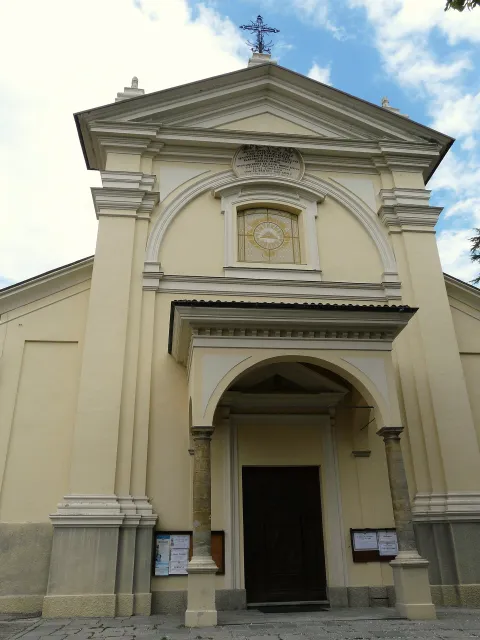
The church of San Siro was founded in 1311 by a local nobleman, one Antonio Pelletta, who attached to the foundation a condition that would weigh on it for centuries: the archpriest was always to be a priest of Nizza.
What to see
That clause, together with the right of patronage, produced extremely long disputes involving the noble families of the area, the town council and the bishop's curia, which reached judgement before the Sacred Rota. Meanwhile the building grew: from the very modest proportions of its origins to the decisive enlargement between 1790 and 1800, which gave it its present shape.
Visiting
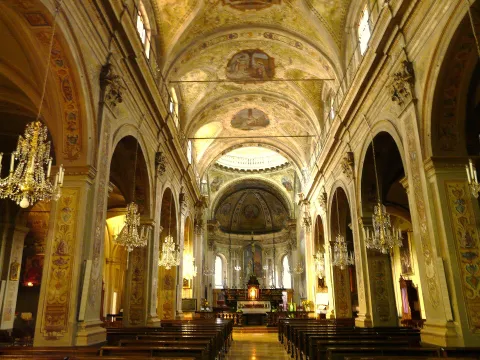
Three naves, the side ones about half the width of the central one, two bays, a wide rectangular presbytery and a semicircular apse crowned by a level full of openings: that is where the light comes from. Variegated marble balustrades separate the naves; the ceilings are frescoed and loaded with stucco, frames and gilding, while the walls are painted in false marble. As at San Giovanni, the transepts are almost cancelled in favour of the sacristy on the right and a service room on the left. Between 1939 and 1943 canon Alessandro Thea directed the redecoration, and two large frescoes reached the presbytery walls: Christ the King by Paolo Giovanni Crida and the Coena Domini by Pietro Dalle Ceste.
Our editors' tip
The choir has only been properly visible since the old marble altar, dark and bulky, was dismantled: look at it from the presbytery. Outside, along the flank, stand remains of the Benedictine nuns' convent, now absorbed into the hospital: a graft that explains on its own how this part of Nizza grew.