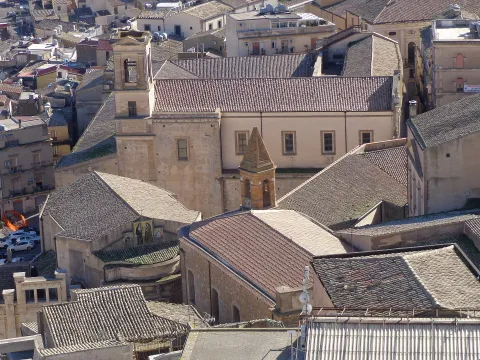
An inscription once set over the main doorway, dated 1282 and bearing the name of the architect Magister Gofredus, is the oldest documented trace of San Giuliano, the mother church of Caltagirone and seat of its diocese. From that first Norman-Aragonese building — leveled and rebuilt after the earthquakes of 1542 and 1693 — the church stands today as a Latin-cross structure recast in a Tuscan idiom during the eighteenth century and crowned, between 1908 and 1913, by a façade designed by Saverio Fragapane. In 1948 Pope Pius XII raised it to the rank of minor basilica; the honor was celebrated on 27 January 1949, the feast of Saint Julian, with a solemn pontifical Mass led by Bishop Pietro Capizzi.
What to see
The present front, in an Art Nouveau register, closes a building history that ran for centuries. From the eighteenth-century church rebuilt after the Val di Noto earthquake come the basilica plan on a Latin cross, the three aisles divided by pillars, and the broad dome: the Agrigento architect Simone Mancuso, aided by the Palermo carver Giuseppe Montes, cleared away the old Norman fabric, raised new white-stone columns, and completed the three-light bell tower in 1756. Two stone portals open on the outer walls, designed in the later eighteenth century by Natale Bonaiuto of Syracuse. Inside, the vault of the central nave carries the cycle painted in 1862 by Giuseppe Vaccaro, five panels drawn from the Old and New Testaments — from the Sacrifice of Abel and Noah's Ark to the Offerings of Melchizedek and the carrying of the Ark to Jerusalem; over the presbytery the Institution of the Eucharist reworks Leonardo's Last Supper. On the triumphal arch an allegorical stucco of the Christian Religion holds up the monstrance and unfurls a scroll with a line from Saint Thomas Aquinas's Tantum Ergo. Among the works are a sixteenth-century crucifix in black wood attributed to the Messina sculptor Giovannello de' Matinati, a marble Madonna della Mercede from the Gagini workshop, and the Dead Christ carved in 1850 by Giuseppe Vaccaro from a single cypress trunk.
Visiting
The wooden Dead Christ is kept in an urn and carried in procession on Good Friday, followed by the float bearing the Madonna Addolorata, a sculpture of 1856 by Vincenzo Nigido, draped in black velvet with her heart pierced by a silver blade. Other works by the Vaccaro family and Giuseppe Barone's 1936 canvas of Saint Charles Borromeo at prayer are held in the diocesan museum.
Our editors' tip
Visitors who come to Caltagirone for its ceramics should not treat the cathedral as an afterthought: look up at the three-light bell tower, where a niche holds the bronze Madonna cast in 1950 by Ugo Tarchi, and find on one of the side doors the 1773 epigraph recording how the town replaced its old clock with a “more accurate” one. If you can, plan your visit during Holy Week, when the Dead Christ is carried through the streets.