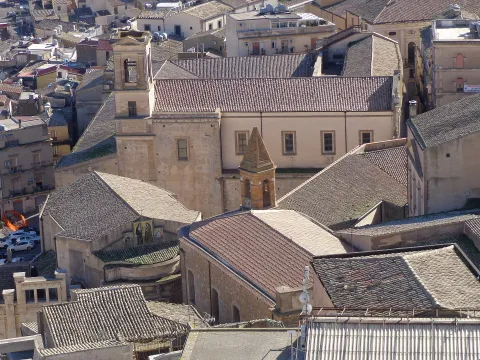
Above the doorway, in a niche holding a stone figure of the saint dated 1625, a majolica panel shows Francis of Paola crossing the Strait of Messina on his cloak: in Caltagirone, a town of potters, even miracles are told in ceramic. The building started as the small church of Sant'Antonio Abate, attached to a Dominican convent along via Carolina, today via Roma; in 1582 the civic Senate handed it to the Order of Minims, who enlarged it and gave it the name of their founder.
What to see
The Minims' work ran from 1592 to 1605 and gave the church the two white stone portals of late Renaissance taste that are still in place. The facade and the left flank are precisely the parts left standing by the earthquake of 11 January 1693: in a town almost entirely flattened and rebuilt in Baroque, this is a piece of the Caltagirone that came before the disaster.
Inside, the statue of the patron saint stands in the apse; along the sides of the presbytery and at the relic altar hang canvases, among them the San Vincenzo de' Paoli and the Addolorata by Francesco Vaccaro, a painter from the town. Much of the furnishing was not made for this church: it came from others in Caltagirone. The convent next door, along the same street, was turned into a hospital in the second half of the 19th century. On 12 December 1926 monsignor Giacomo Carabelli, archbishop of Syracuse and apostolic administrator of Caltagirone, raised the church to parish rank; its consecration came only on 3 May 2025, with bishop Calogero Peri.
Visiting
The church is on via Roma, at the corner of piazza Marconi, on the axis that climbs from the lower town towards the old centre: from the Scala di Santa Maria del Monte, the 142 steps with majolica risers, you walk down here along the same street. It is a working parish, so it opens for services and closes in the afternoon: mornings are the safe bet, and mass times deserve respect. Twenty minutes cover the portal, the panel and the interior; make it an hour if you carry on towards the ceramics museum and the public gardens.
Our editors' tip
Before going in we stand on the pavement opposite, in the morning, when the sun hits the front: from there the majolica panel over the doorway reads clearly, colours and figure of the saint included, and you can measure the distance between that sixteenth-century design and everything Caltagirone built after 1693. Then we walk up via Roma slowly: it is the street along which the town stretched itself, and there is something to look at every hundred metres.