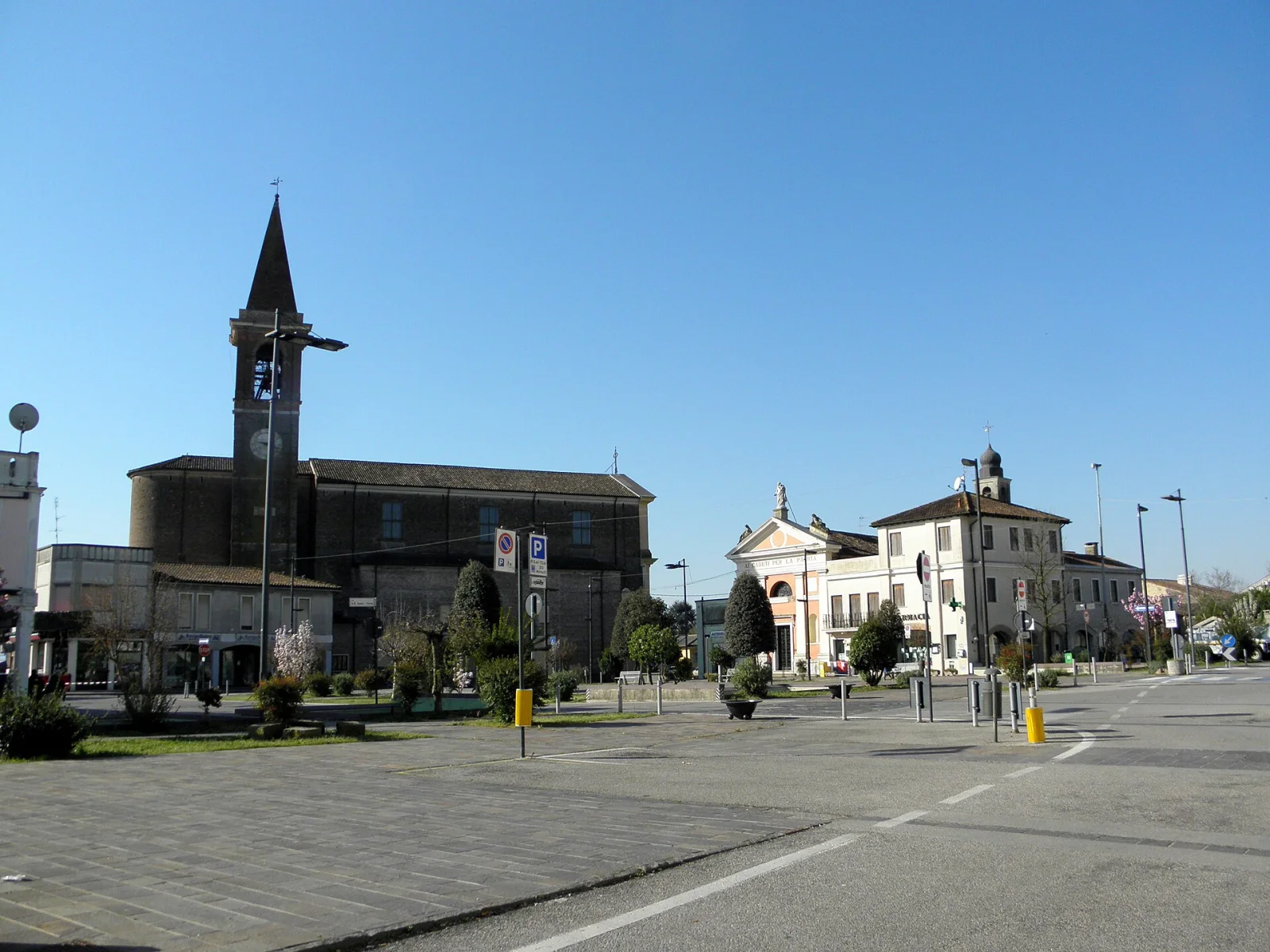
The first documents about this place are of 1146, when the marquis Fulcone d'Este gave twenty mansi of his own land — four hundred and eighty biolche — to the monastery of San Benedetto di Lairone of Murano, and the Latin deed describes the ground by its four sides: on one the river, on another the ditch called Gaibo, and at the two ends two localities carrying men's names. The bequest was contested by the Benedictines of Pomposa, and the quarrel closed by granting free fishing on the «costa» of a lake in the territory both to the men of Pomposa and to those of Murano. Out of that compromise about fish the name can be read: the Costa is a tongue of land lying between a watercourse — probably the Adigetto, then called the Adige because it was the main branch — and one of the many lake basins of the Polesine. A few years later the Benedictines, with tithes granted them by the bishop of Adria, built a church here dedicated to San Giovanni Battista.
The village grew in two pieces, on the two banks of the Adigetto: Costa on the right, where the Benedictines were, and Costiola on the left, which belonged to the Order of Saint John of Jerusalem — two banks, two religious orders. Medieval documents say the watercourse was navigable then, and that around it lay marshes, the lake and woods, and that the inhabitants turned them into fields and pasture. Then, in 1438, the disastrous breach of the Malopera took most of the flow away from this branch of the Adige in favour of the more northern one, and between the fourteen hundreds and the end of the fifteen hundreds the whole place changed its look. In 1194 the emperor Henry VI had made the Este influence official by naming Azzo VI count, and Este the territory remained for nearly three centuries, until the salt war and the Venetians, who entered Rovigo for good in 1482; the year after, the chronicler Marin Sanudo came through Costa and put it into his Itinerario in terra ferma. As for the river that made the name and split the village in two, it is not there any more: in 1976 the Adigetto was re-sectioned and culverted. When the comune took its arms, in 1995, it put a bridge on them, for the union of Costa and Costiola.
Straight-line distances from the town centre. Tap a point to open its page.
Near Costa di Rovigo
The closest destinations covered by our editors, with straight-line distance.


Places to see within 25 km
Outside Costa di Rovigo, but an easy day trip away.