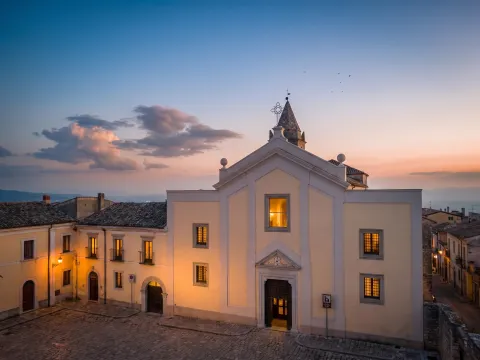
For centuries, anyone who looked up at the top of the cathedral façade in Acerenza believed they were seeing Saint Canio of Atella, patron of the diocese. The marble bust up there was in fact a portrait of Flavius Claudius Julianus, the emperor Christians called the Apostate. A marble cross of recent making now stands in its place at the apex of the façade, and the bust has come down a few metres: it is here, in the Diocesan Museum of Sacred Art, the cathedral museum of Acerenza. It occupies the old Seminary, which archbishop Michele Scandiffio turned into a museum during his seventeen years in Acerenza, from 1988 to 2005.
What to see
That bust is the reason people come: the marble portrait of Flavius Claudius Julianus. The confusion over its identity is probably what saved it, because as long as it was taken for the patron of the diocese nobody had any reason to touch it, and it could stay at the highest and most exposed point of a church consecrated in 1080.
Around it sits the collection of the diocese, and it is worth remembering which diocese that is. A bishop is documented at Acerenza from at least 499, and since 1068 the see has been archiepiscopal: the sacred art gathered in these rooms comes from a church that has been accumulating for almost a thousand years, in a town of little more than two thousand people today. That mismatch between the weight of the history and the size of the place is what makes the museum interesting.
Visiting
There is no separate doorway on the square. You go in through the small door on the left-hand side of the cathedral façade, topped by a round arch and heavily reworked over the centuries: that is the one that leads to the museum today. Treat cathedral and museum as a single visit, and ask inside the cathedral before you turn up.
Our editors' tip
Before going in, stand in front of the façade for a few minutes and find the marble cross at the top: it sits exactly where the bust stood for centuries. Then, once inside, do not look at it head-on. Step to one side, crouch a little and look up at it: that is the only way to see it as the people of Acerenza saw it from the square, foreshortened and against the light, before it came down into a room.