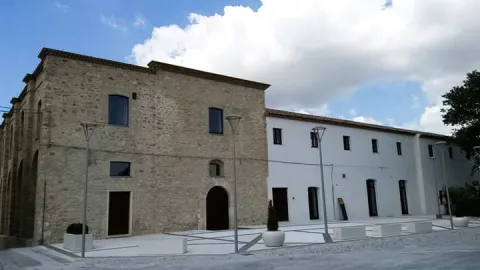
One of the sons of Oppido's Norman lords, a man named Giovanni, left this castle at the dawn of the twelfth century, converted to Judaism and died in Egypt after wandering most of the Mediterranean. The account he wrote of his life, in Hebrew, names the place he came from — Opide — and remains the firmest proof that in the eleventh century Oppido existed and was in Norman hands. The building he walked out of stands on the slopes of the Montrone: everything points to its being raised between 1047 and 1051, in the years when Riccardo Quarel, count of Acerenza, and Drogone of Hauteville were fighting over these lands. Drogone won, and his sons kept Oppido.
What to see
The most precise description we have comes not from an archaeologist but from a valuer. In the early eighteenth century, with the fief impounded over the debts of the Orsini family, the Sacro Regio Consiglio ordered the tavolario Pietro Vinaccia to appraise the village. His report gives an irregular plan, close to a trapezoid, shaped by the awkward ground it sits on, with the main front along the long side and four crenellated towers: two square ones at the corners, two round ones in the middle, guarding the gate you reached over a drawbridge.
Little of that survives. Two of the cylindrical towers are gone; the third still appears in a photograph from 1915. In 1880 the heirs of the last feudal lords, the De Marinis marquises of Genzano, sold the building to a lawyer, Gerardo De Pilato, who demolished part of it and altered the rest until the original layout became almost unreadable. The east wing, where the lords lived, still stands on its high walls, hemmed in by houses built hard against it.
Visiting
This is not an equipped monument, and most of the fabric is in poor condition: what can be read is read from outside, walking around the east wing and looking for the points where the old masonry surfaces between the later houses. Start from the side of the long front, which was the monumental entrance, and keep the scale in mind: in the hearth count of 1642 the place was registered as castrum magnum, and it was the size rather than the shape that struck the men who described it.
Our editors' tip
Put your back to the wall of the east wing and look towards the Bradano valley. The castle was built to control that corridor between the Melfi country and the inland hills, and to hold together the farmers the Normans wanted to draw here — not to withstand sieges. It faced one, or nearly: in March 1348 the Hungarian troops of king Louis tore through the village, which had stayed loyal to queen Joanna. It is the only feat of arms its history has handed down.