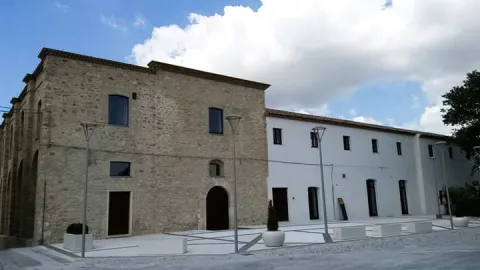
The farmstead you come to six kilometres from Oppido Lucano rests in part on a Roman castellum aquae, the tank that collected water from a spring a kilometre further up the slope. It is the most visible sign of what lies underneath: a Roman villa built along the line of the via Herculia, the road that linked Venusia to Heraclea, and never truly abandoned, because the site is still lived in today. That water served the main house and the fullonica, the room where the wool produced on the estate was washed.
What to see
Of the first villa, late republican, there remain the basis villae with a cryptoporticus and the traces of an atrium with a peristyle: the layout followed the villa rustica scheme of its day, with the working quarters entered from the peristyle and the residence reached from an ambulatio whose façade was designed for effect. The floors were mosaic, with the four seasons on them; those mosaics are no longer here, having been lifted and taken to the Museo Archeologico Nazionale in Muro Lucano.
The high point is the second century, under Hadrian and the Antonines: twenty rooms floored in opus sectile and mosaic occupy the south-western part of the terrace, while to the north stand the baths, on a mixtilinear plan, fed by an aqueduct and by the castellum aquae, of which a few pillars survive. Beside them worked the craft quarter, with a kiln for bricks, a space for the dolia and the fullonica. Then the decline: from the third century some rooms are rebuilt and others given a monumental turn, and an apsed hall appears in the south-western sector; in the fourth century tile-covered graves cut straight through what had been the wool-washing floor.
Visiting
This is not an archaeological park: a working farmstead sits on top of the ruins and the property is private. Serious investigation began in the early twentieth century, when the superintendency identified a monumental balneum and a pool among the central buildings, and became systematic in 1989 with the Italian-Canadian mission of the University of Perugia and the University of Alberta, which measured the scale of the bath complex and the intricacy of the pars urbana. To see anything with your own eyes, the stop that counts is the museum in Muro Lucano, where the mosaics are.
Our editors' tip
Ask at the Muro Lucano museum which room the four seasons mosaics came from, then come back here and look for the spot: it is the only way to put back together a villa that archaeologists have compared, for the richness of its decoration and the size of its baths, to the public bathing complexes of Velia and Paestum. And look for the spring a kilometre up the slope — that is where the aqueduct started.