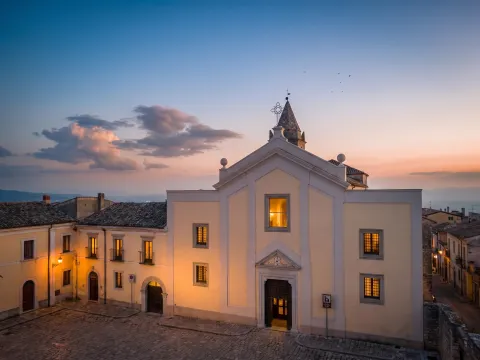
Two older buildings lie under Acerenza Cathedral: an early Christian church and, beneath it, what was left of a Roman temple to Hercules Acheruntinus. Work on the present church began in 1059, paid for by the generosity of Robert Guiscard and started under bishop Godano; it was finished by his successor Arnaldo with French masons supplied by the Normans, and that is where the ambulatory with three diverging apses around the choir comes from, a rare arrangement in Italy. The earthquake of 1456 and a long line of non-resident archbishops left the building abandoned; the full restoration came only in 1524, ordered by the Ferrillo counts.
What to see
The front is lopsided because the right slope is cut by the bell tower, reworked in 1555 by master Pietro di Muro Lucano, whose name is still legible under the first window. Fragments of Roman sarcophagi with the faces of the dead, and the remains of a funerary altar, were built into the tower walls; of the five bells, the largest was cast in 1854 by Girolamo Olita. The central doorway, in the Apulian Romanesque manner, keeps a mutilated porch: the lions are missing from the base of the small columns, and one of them now sits high on the left corner of the facade. On the corbels, lions and monkeys grip two human figures. Above the doorway are the Ferrillo arms and the relief of the Basilisk, once part of the old town coat of arms.
Inside, 69 metres long and 23 wide, three aisles divided by ten piers under an open truss ceiling. The right transept holds Antonio Stabile's polyptych of 1583, the Madonna of the Rosary with fifteen scenes; the left one his Pietà, set in a marble arch. The raised presbytery runs around the choir with three radiating chapels; in the first, dedicated to Saint Michael, stands the balustrade by Anton Ludovico Antinori. Below is the Ferrillo crypt, consecrated in 1524 and built on the model of the Succorpo chapel of San Gennaro in Naples: four central columns, a groin vault of nine bays, frescoes by Giovanni Todisco da Abriola and the tomb with the portraits of Giacomo Alfonso Ferrillo and Maria Balsa.
Visiting
You go in through the central doorway; the small door on the left leads instead to the cathedral museum, which keeps the marble bust of the emperor Julian, for centuries fixed to the facade and taken for Saint Canius. The crypt is reached by the side stairs put in during 1953, when the way up to the presbytery was rebuilt. The church has been a minor basilica since 1954.
Our editors' tip
Before going in, walk around the outside of the apse and look closely at the squared stones of the upper wall, under the cornice of hanging arches: they are covered with lichens that change colour when the weather turns from dry to damp, so the cathedral you saw in the sun is not the one you will see after rain.