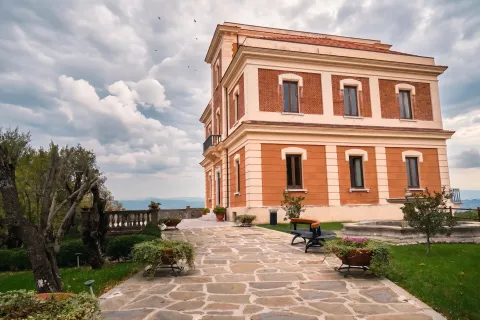
Before any pottery or inscription, the display cases of the Museo nazionale dell'Alta Val d'Agri line up tusks and molars of elephants and horses: the state collection at Grumento Nova starts with the palaeontology of the valley and only afterwards gets to people. The museum is recent, set up at the end of the twentieth century next to the archaeological park of Grumentum, and it gathers what has come out of the whole Val d'Agri, with a large part given over to the Roman town at the foot of the hill. Since December 2014 the state has run it through the Polo museale della Basilicata, which became the Direzione regionale Musei in December 2019.
What to see
The ground floor is entirely pre-Roman. There are Bronze and Iron Age pottery fragments decorated with geometric motifs and dotted bands, and then the Oenotrians, the valley's indigenous people, recognisable by their long spiral armlets; a few Ionian cups record contacts with the Greeks. Grave goods of the Classical and Hellenistic periods bring large black-glaze vases and bronze sets for banquet wine, while women's burials yield figs and walnuts modelled in terracotta. Look closely at the guttus with a fig leaf in relief on its disc and a saltire cross under the spout, and at the Attic red-figure pelikai attributed to the Haken Painter.
The basement is Roman Grumentum, split into six groups by excavation site or type of find. It opens with stone: a portrait of Livia from the first century, a funerary stele with a married couple, a fragment of an ivory pyxis with a symposium scene. Then come the town's four temples, with terracottas, painted plaster, small bronze bells and a torso of Harpocrates that documents Egyptian cults already between the first and second centuries; the House of the Mosaics supplies waterspouts and many stamped roof tiles. The cemeteries close the sequence, with cinerary jars and unguent bottles, along with the epigraphy room, where the honorary slab of Tiberius and the one of Hadrian stand beside Lucanian funerary cippi and coins, from Greek issues of the fourth century BC to Roman ones of the fifth century AD.
Visiting
The building has two levels and you walk it downhill: the pre-Roman on the ground floor, then the Romans on the level below. Along the way the panels reconstruct how the main monuments of Grumentum looked, and that is the best reason to come in here before going down to the excavations, which are next door: the theatre, the amphitheatre and the baths read far better afterwards. The museum stands just above the lake of Pietra del Pertusillo.
Our editors' tip
Do not leave before the last case in the Roman section, the one with late antique and early medieval grave goods: beside knives, combs and earrings there are a brooch shaped like a bird with outspread wings and a signet ring. By then the Roman town has stopped being one, and you can see it.