The earliest document naming a church of Sant'Antonino at Grumento Nova is an inscribed stone of 1118, and even then the site was not starting from scratch: the building had most likely gone up on the remains of a pagan temple dedicated to Serapis, a god of Egyptian origin. Almost nothing of that medieval church survives, because the earthquake of 1857 destroyed it outright and the parish church you walk into today is the neoclassical rebuilding that followed. Ten years later, in 1867, a dispute between the archpriest and the bishop of Marsico Nuovo cost it its rank of collegiate church.
What to see
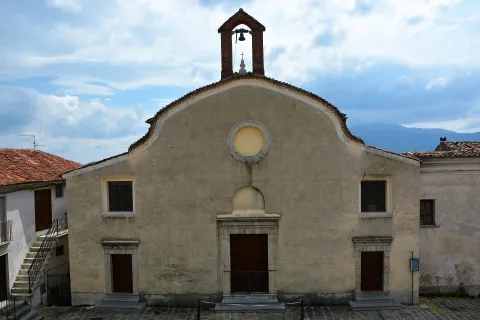
The gabled front faces south-west and is split by a cornice into two registers, each marked out by four pilaster strips: below, the pedimented doorway with a niche on either side; above, a window and the triangular gable, crowned by a small bell-cote. The bell tower proper stands against the flank, square in plan, with one round-arched single-light opening on each face of the belfry and a four-pitched roof.
Inside, the plan is a Latin cross but there is a single nave under a flat ceiling; the transept arms open through round arches, the walls are paced by pilasters carrying a moulded, projecting entablature, and above it runs an attic register pierced by windows. Two things deserve a slow look: the fragments of 16th-century frescoes and a Last Supper painted in the 19th century.
Visiting
This is the parish church of the village, in the Val d'Agri pastoral district of the archdiocese of Potenza-Muro Lucano-Marsico Nuovo, so opening hours follow the schedule of services. What you see carries the date of three recent building campaigns: in 1975 the post-conciliar liturgical rearrangement, with an altar turned towards the congregation; after the Irpinia earthquake of 1980 the repair of the cracks, finished by the middle of that decade; and between 2013 and 2014 the complete renewal of the heating and electrical systems.
Our editors' tip
Count the belfries before you go in: there are two, the little bell-cote on the gable and the square tower against the flank, and together they tell two different chapters of the same church. Then stand in front of the façade in late afternoon, because it faces south-west and that is the hour when raking light lifts out the four pilasters of each register and the pediment over the door.