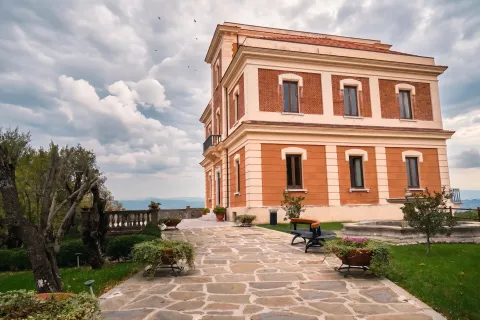
Eni's offices in Viggiano sit inside a Franciscan friary. The complex, on the edge of the built-up area, was founded in 1478 by the Order of Friars Minor and was called the Convento di Santa Maria del Gesù; the conventual church, now dedicated to Saint Anthony of Padua, was built between 1542 and 1546 and is the only part of the complex still doing the job it was made for. Everything else has changed use repeatedly: a boarding school from 1873 to 1895, the seat of the local Carabinieri company from 1900, and then the oil company's offices and the Museum of Popular Traditions.
What to see
The church has the spare plan of the mendicant orders: a single nave under a barrel vault. Alterations piled up over time, since the friary was rebuilt from scratch in 1646 and heavily reworked in the 18th century, and the church too was retouched more than once. The one fitting worth the stop has stayed where it was, though: the 18th-century wooden choir behind the altar.
Visiting
The church is the only room in the complex still in liturgical use, so you will find it open around services; the other wings are taken up by the Eni offices and by the Museum of Popular Traditions, which is also the simplest way into the rest of the building. The friary stands on the edge of the town rather than in the old centre: walk up to it from the village and you get the measure of how far from the houses it was when the friars founded it.
Our editors' tip
Do not stop at the church: the Museum of Popular Traditions, in the same complex, tells the story of the Viggiano that built harps and sent players halfway around the world. Seen before or after the choir stalls, it explains the town better than any plaque.