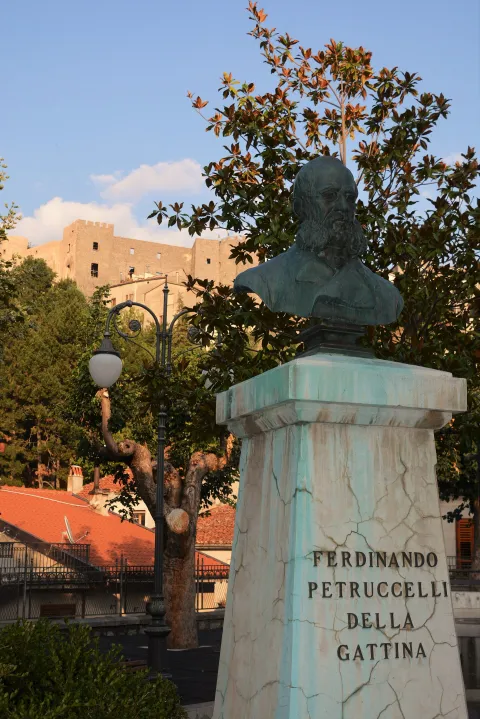
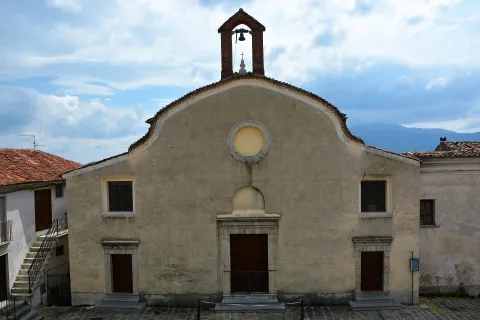
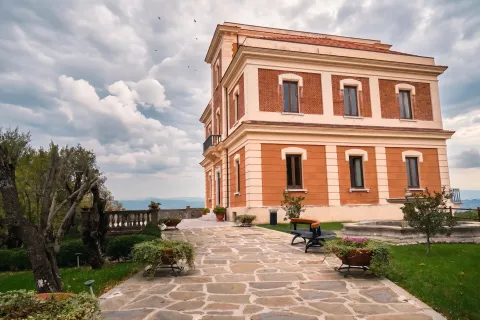
In 207 BC Hannibal pitched camp against the walls of Grumentum, and it was there that he was beaten: the Romans who drove him off came from Venosa under Gaius Claudius Nero, eight years after a first clash below the same town in 215 BC. The colony had been founded in the 3rd century BC as a fortified outpost of the Samnite Wars, in almost the same years as Venusia (291 BC) and Paestum (273 BC), on a road junction: the route that became the via Herculea, between Venosa and Heraclea, ran through here. In 370 Grumentum became a bishop's seat, then Saracen raids emptied it, and in 954 its people founded Saponara on the hill above, today's Grumento Nova.
What to see
The town stretches along the ridge, following the lie of the land: three parallel main streets crossed at right angles by secondary ones, a wall circuit of about 3 km with six gates, 25 hectares of which only a tenth has been uncovered. The theatre is Augustan and was restored between 1964 and 1968 by Dinu Adameșteanu, the first superintendent of antiquities for Basilicata; beside it stand two small temples of imperial date and a house archaeologists call the Casa dei mosaici for its 4th-century mosaic floors. The forum was closed by porticoes, with two temples on the north and south sides, tentatively identified as the capitolium and a temple of the imperial cult, and the remains of a basilica to the west.
The amphitheatre is the only one in Lucania. Built in the 1st century BC on the north-eastern edge of the town, beside an access road that let spectators coming up from the valley get in without crossing the city, it sets its western flank against the natural slope of the hill and rests its eastern one on an entirely man-made substructure; the seating runs to two tiers only. The republican baths still carry the inscription naming the praetors and duoviri Q. Pettius and C. Maecius, who had them built at public expense: the calidarium keeps two mosaics, one white and one polychrome with Greek key and braid patterns, laid over the suspensurae of the heating. The imperial baths, Augustan, hold instead a black-and-white mosaic full of sea creatures, tritons and Scylla.
Visiting
The park is walked on the flat, in the Spineta district at the foot of the hill; the national archaeological museum holding the finds is up above, in Grumento Nova. Visitor facilities are housed inside the republican baths, in the very rooms where the round frigidarium was turned in modern times into a palmento, for pressing grapes and fermenting the must. The amphitheatre, never wholly lost and already described by local scholars in the 18th century, was properly excavated only from 1981, after the 1980 earthquake had worsened the risk of collapse.
Our editors' tip
Go up to Grumento Nova and look closely at the town gate. In the first half of the 19th century Andrea Lombardi, describing these ruins, noted that the so-called Porta Aquilia of Grumentum had been stripped of the marbles that decorated it, and that those marbles had ended up on the gate of Saponara, the name Grumento Nova carried for centuries. Look for them: the town above is made, quite literally, out of the city below.